
Frederick Simpson Coburn (1871-1960), also known as F. S. Coburn, was born in the village of Upper Melbourne in the Eastern Townships of Quebec. He was a prominent Canadian painter, illustrator, and photographer.
At a young age, his artistic talent was noticed by the Irish-born Canadian poet William Henry Drummond. It was Drummond who brought Coburn to the attention of the Notman and Fraser Firm. They pointed him to the Council of Arts and Manufactures School in Montreal, where he briefly studied before transferring to the Carl Hecker School of Arts in New York. From there, he travelled to Europe to study at the Royal Academy in Berlin (1890); under Jean-Léon Gérôme in Paris; and at the Slade School of Fine Art in London under Henry Tonks. While in England, Coburn created paintings for the London Sporting and Dramatic News and illustrations for the London News.
 Self-portrait, 1901, chalk on paper by Frederick Simpson Coburn
Collection Musée des beaux-arts de Sherbrooke
His relationship with William Henry Drummond lasted into adulthood and in 1896, he illustrated the first volume of Drummond’s poetry. This collection, titled The Habitant (1897), was focused on rural Quebec society. In order to create images for it, Coburn spent weeks living among and drawing local families. Throughout his career, he illustrated all of William Henry Drummond’s works.

Red Sleigh, Eastern Townships, 1947, oil on canvas by Frederick Simpson Coburn
In 1897, he returned to Europe to further his skills at the Institut Supérieur des Beaux-Arts in Belgium with Albrecht de Virendt. During this time, he took to painting Dutch thatched roof cottages, cattle, beaches, windmills, and interiors. Because of the time he spent in Europe, he became fluent in German, Dutch, and Flemish. In 1898, he won the Belgian Government’s “Goot” subsidy that enabled him to study tuition-free for three years.
In 1899 he illustrated Louis Fréchette’s Christmas in French Canada and the French edition La Noël au Canada the following year. Coburn then collaborated with the G. P. Putnam Company of New York and worked to illustrate books by Charles Dickens, Edgar Allen Poe, Alfred Lord Tennyson, and others. He also created images for magazine articles and covers.

Illustration, c. 1899-1900 by Frederick Simpson Coburn for Charles Dickens' A Christmas Carol
At the turn of the century, he painted still lifes of subjects such as flowers, portraits, and spring and summer landscapes of Quebec’s Eastern Townships. They had a dark tone to them.

Danville Roses, 1916, oil on canvas by Frederick Stanley Coburn
National Gallery of Canada
His stay in Antwerp, Belgium ended in 1913 when he came back to reside in Canada. The following year he embarked on sketching trips with Canadian artist Maurice Cullen, who was known for his scenes of the Laurentians. These voyages influenced Frederick Coburn’s approach to painting, and he began using oils and experimenting with colour and the effects of light.
Throughout the later phase of his career, his work was exhibited both nationally and internationally. Two canvases were exhibited at the Imperial Gallery of Art Exhibition in London, England in 1928. His painting, March Morning, won the 1929 Art Association of Montreal’s Jessie Dow prize. In 1932, a special exhibition of his Drummond illustrations was held at the Arts Club of Montreal. In 1936, he received an Honorary Doctorate of Civil Law conferred upon him by Bishop’s University at Lennoxville, Quebec. Coburn exhibited two paintings in London in the Tate Gallery’s A Century of Canadian Art showcase.
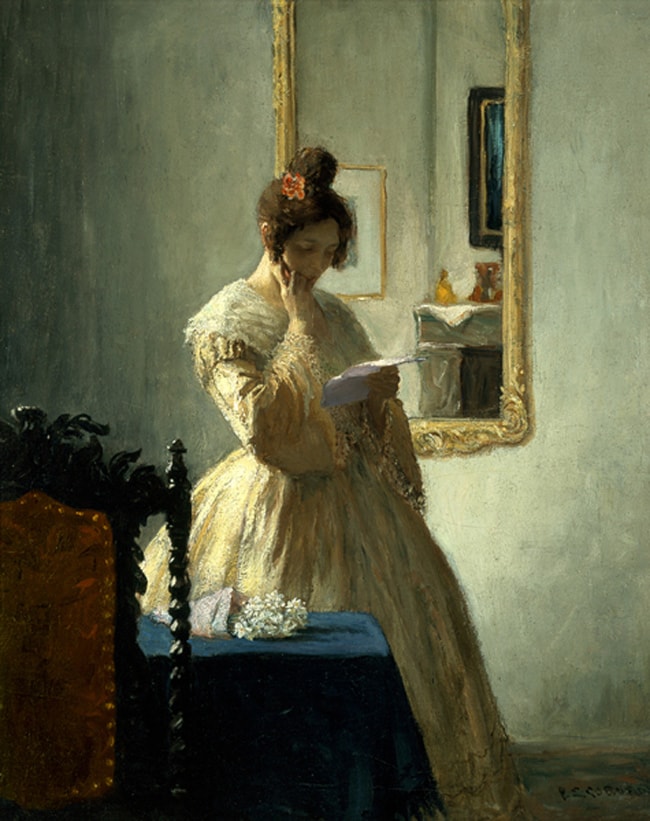
The Letter, c. 1905, oil on canvas by Frederick Simpson Coburn
Art Renewal Center
His wife, Malvina Scheepers, died in 1933. She was an artist from Belgium, and they met during his stay in Antwerp. Upon returning to Canada, they set up a studio-home in Upper Melbourne, Quebec and also had a residence in Montreal. After her death, Coburn was inspired by Carlotta, who was a dancer and model that he often painted in her dance costumes. She was born in Quebec as Marguerite Charlotte Lavoie. Carlotta built her dance career in Montreal between 1930-1950 with her romantic and dance partner, Alvarez (Gérard Hébert). While working as a model, she met Frederick Simpson Coburn in 1933 and was included in several of his paintings and photographs. He became educated in dance through Carlotta, and Coburn even provided financial backing to Carlotta and Alvarez when they opened a dance studio in Montreal.

Frederick Simpson Coburn and Carlotta, photograph
Collection de Musée national des beaux-arts du Quebec
In 1941, he became a full member and Senior Fellow of the Royal Canadian Academy of Arts. His memberships extended to the Pen and Pencil Club of Montreal, where he was President in 1942. Coburn’s works are part of public collections like the National Gallery of Canada; the Musée national des beaux-arts du Quebec; the Musée des beaux-arts de Sherbrooke, Quebec; the National Gallery, Brisbane, Australia; and The Tate Gallery, London, England. His pieces are also in galleries in Japan, Belgium, and the United States of America.

Logging in winter, 1931, oil on canvas by Frederick Simpson Coburn
He is perhaps best-known for his winter scenes of Quebec’s Eastern Townships. These distinctly regional works are famous for their snow-covered landscapes that feature horse-drawn wagons or sleds that are often transporting logs and figures. These bright winter scenes show a more Canadian approach to his patinating in opposition to his earlier, darker works that were more influenced by the European style he trained under. On May 26, 1960, Frederick Simpson Coburn died peacefully in his Melbourne studio at the age of 89.
Bibliography
"Coburn, Frederick Simpson" A Dictionary of Canadian Artists, volumes 1-8 by Colin S. MacDonald; volume 9 by Anne Newlands and Judith Parker, Library and Archives, National Gallery of Canada/ Musée des beaux-arts du Canada.
"Coburn, Frederick Simpson (1871-1960)," Eastern Townships Archives Portal, maintained by Bishop's University.
"Frederick Simpson Coburn," Musée des beaux-arts de Sherbrooke.
"Frederick Simpson Coburn," Musée National des beaux-arts du Quebec.
"Frederick Simpson Coburn," National Gallery of Canada.