
Antoine-Sébastien Plamondon (1804–1895) was one of the important painters of nineteenth-century Quebec. He is best known for his portraits and religious paintings, where he developed a distinctly academic style after studying in Paris and returning to Quebec and establishing a successful career painting members of the province’s religious and secular communities. His work provides a valuable record of nineteenth-century Quebec society, particularly its emerging middle and upper classes. His religious paintings, meanwhile, became an important part of the visual culture of churches and religious institutions around Quebec City.
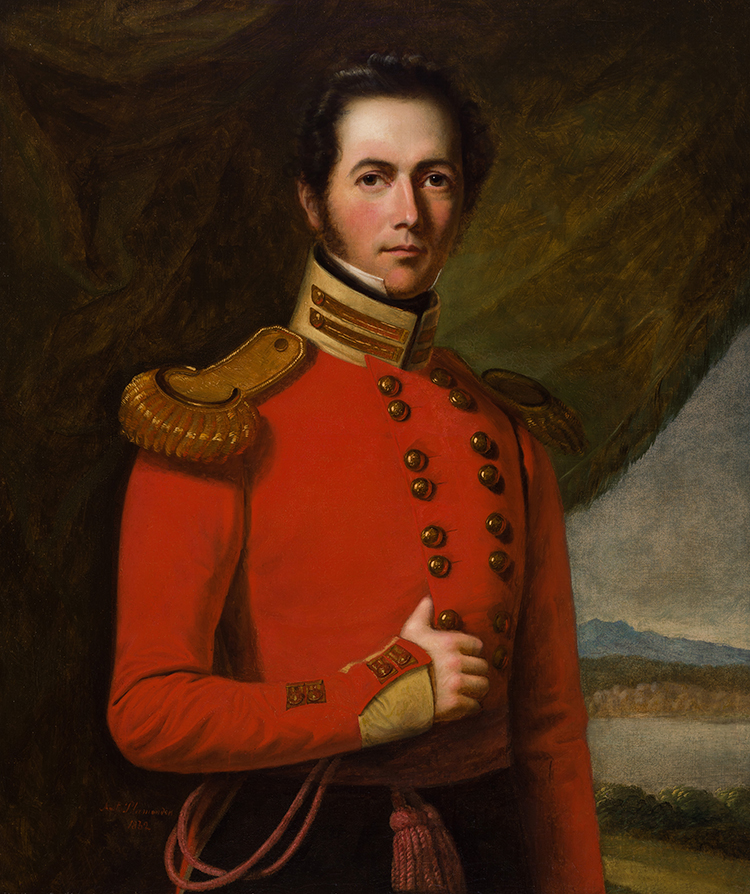
Le Capitaine Charles Campbell, 1832, oil on canvas by Antoine Plamondon
Private Collection
Plamondon was born at L'Ancienne-Lorette, Quebec, around 1804. After attending school in Saint-Roch, he was apprenticed to the Quebec painter and picture restorer Joseph Légaré. From approximately 1819 to 1825, Plamondon worked with Légaré, gaining experience as both a painter and a restorer. During this period, he helped restore works from the Desjardins Collection, a group of European paintings that had been brought to Quebec after the French Revolution. This experience in his young adult life introduced Plamondon to European painting and gave him a technical foundation. It also helped create the classical approach that would remain an important characteristic of his work throughout his career. In 1826, at about twenty-two years old, Plamondon travelled to Paris to continue his artistic education. He studied with Jean-Baptiste Paulin Guérin, a prominent French portraitist who had been associated with the academic tradition of Jacques-Louis David and had served as a court painter.

Adèle Fortier, 1834, oil on canvas by Antoine Plamondon
National Gallery of Canada
Plamondon spent approximately four years in France. His Paris training exposed him directly to the French academic tradition and reinforced his interest in portraiture and classical composition. He returned to Quebec in 1830, at a time when political upheaval was taking place in France. Back in Quebec, he began building the career for which he would become best known.
Plamondon became one of the most sought-after portrait painters among Quebec's nineteenth-century bourgeoisie. His portraits captured members of the secular and religious communities, including prominent families and members of religious orders. His early portraits are often tightly composed, with the sitter shown prominently and directly. His attention to clothing and facial expression also provides a record of contemporary fashion and social identity.

Julie Papineau (née Bruneau) and her Daughter Ezilda, 1836, oil on canvas by Antoine Plamondon
National Gallery of Canada
His most productive period was approximately 1835 to 1845. During these ten years, he received numerous portrait commissions, including portraits of four young nuns from prosperous Quebec families who served at the Hôpital-Général in Quebec City. One example is Sister Saint-Alphonse (1841). The composition reflects Plamondon's academic training: the nun's habit creates a strong triangular form, while the book she holds shows her religious devotion. The chair and surrounding lines further emphasize the sitter's presence.

Sister Saint-Alphonse, 1841, oil on canvas by Antoine Plamondon
National Gallery of Canada
Although Plamondon became particularly well known for portraiture, religious painting formed a substantial part of his career. More than half of his total body of work is said to consist of religious subjects. Churches and religious orders around Quebec City commissioned many of these works. Rather than inventing entirely new compositions, Plamondon frequently based his religious paintings on European Old Master works and engravings. This practice was common among artists of the period and provided Canadian churches with versions of important European religious compositions. Plamondon was an accomplished copyist and drew inspiration from artists including Raphael, Jacques-Louis David, Titian, and Peter Paul Rubens, as well as his teacher Paulin Guérin. His religious paintings reveal the importance he placed on classical composition, colour, facial expression, and the ability to convey spirituality through the people he depicted.

Father Charles Chiniquy, 1841, oil on canvas by Antoine Plamondon
National Gallery of Canada
Around 1850, Plamondon moved from Quebec City to Neuville, where he lived for the remainder of his life. He established a studio there and lived as a gentleman farmer with members of his family. Although religious commissions remained an important part of his later career, Plamondon also produced secular works. These included The Flute-player (1867) and Still-life with Apples and Grapes (c. 1870), demonstrating that his practice extended beyond portraiture and religious subjects. By 1871, he had also begun producing portraits from photographs, an indication of the changing circumstances of portrait painting in the nineteenth century.

Still-life with Apples and Grapes, c 1870, oil on canvas by Antoine Plamondon
National Gallery of Canada
His artistic style, however, remained in the classical tradition he had learned decades earlier in Paris. As artistic tastes changed during the late nineteenth century, his approach increasingly belonged to an earlier generation of Canadian painting. Plamondon painted his last known work, a self-portrait dated 1882, when he was in his late seventies. He was elected an Associate of the Royal Canadian Academy of Arts in 1880, an important recognition late in his career. He remained in Neuville until his death in 1895.

The Flute-player, 1867, oil on canvas by Antoine Plamondon
National Gallery of Canada
Today, Plamondon's paintings are important not only as examples of nineteenth-century Canadian academic painting, but also as records of Quebec society during a period of significant cultural change. His portraits preserve the appearance and social identity of people from Quebec's religious and secular communities, while his religious paintings document the visual traditions that shaped Catholic art in the province. As art historian John R. Porter has observed, Plamondon's skill as both a painter and an observer of human character made him a revealing chronicler of Quebec society in the middle of the nineteenth century. Plamondon's career also illustrates the connections between European academic traditions and Canadian painting. After receiving his training in Paris, he brought the French academic approach back to Quebec, where he adapted it to the demands of portraiture, religious art, and the growing cultural life of nineteenth-century Canada.

Still-life with Two Dogs, oil on canvas by Antoine Plamondon
National Gallery of Canada
Consignment at Rookleys
At Rookleys Canadian Art, we are actively seeking works by Antoine Plamondon for consignment, offering consignment rates far lower below what auction houses charge. If you have a piece by Antoine Plamondon to consign, please contact us at info@rookleys.com to discuss these opportunities further.

Louis-Joseph Papineau, 1836, oil on canvas by Antoine Plamondon
National Gallery of Canada
Bibliography
Hubbard, R. H. Antoine Plamondon 1802–1895, Théophile Hamel 1817–1870: Two Painters of Quebec / Antoine Plamondon 1802–1895, Théophile Hamel 1817–1870: Deux peintres de Québec. National Gallery of Canada, 1970.
Musée national des beaux-arts du Québec. Antoine Plamondon, 1804–1895: Jalons d’un parcours artistique. Musée national des beaux-arts du Québec, 2005.
National Gallery of Canada. “Antoine Plamondon.” National Gallery of Canada.
Porter, John R. “Plamondon, Antoine.” Dictionary of Canadian Biography, vol. 12. University of Toronto/Université Laval, 1990.
Québec, Ministère de la Culture et des Communications. “Plamondon, Antoine.” Répertoire du patrimoine culturel du Québec.