
Sophie Pemberton was born in Victoria, British Columbia, in 1869. She grew up in a prosperous and well-connected family at Gonzales, in what is now the Oak Bay area. Her interest in art appeared early. At just thirteen years old, she contributed two watercolours to an album of artwork created for Princess Louise during a visit to Victoria. She was the youngest contributor to the project. Painting outdoors was still considered an acceptable pastime for young women of her social background, but Pemberton's ambitions went considerably further. She did not want art to remain a hobby, she wanted to become a professional artist.

Daffodils, oil on canvas, 1897 by Sophie Pemberton
Royal BC Museum, Victoria
In 1889, Pemberton returned to England with her mother and sister to begin formal art training. She chose a serious academic program rather than one intended simply to provide women with a pleasant artistic pastime. At Arthur Cope's school in South Kensington, she studied anatomy, drew from plaster casts, and worked from live models.
She later attended the Clapham School of Art and the Westminster School of Art. Her dedication was rewarded in 1893 when she achieved first-class results in drawing from the antique, drawing from life, and still-life painting, placing her among the top students in each category.

Spring, oil on canvas, 1902 by Sophie Pemberton
Art Gallery of Greater Victoria
Pemberton's most important period of training came in Paris. In 1898, she enrolled at the Académie Julian, one of the leading private art schools in Paris. The school was particularly important for women artists because its students competed in many of the same artistic competitions as men. Pemberton quickly distinguished herself. In 1899, she won the Prix Julian, a medal and monetary prize awarded for the best portrait in a competition involving students from the studios of two prominent instructors. The competition was open to both men and women. She won again the following year. During these years, she also exhibited in London, Paris, and other British cities, establishing a growing reputation as a portraitist.
Pemberton established a studio in Chelsea, London, and became part of an active community of artists. Her studio environment brought her into contact with other women artists, including Canadian and European painters. In 1897, one of her paintings, Daffodils, was accepted for the prestigious Royal Academy of Arts exhibition in London. The following year she was accepted again. Her work was also shown internationally. One of her paintings, Tarring Ropes, was included in the Canadian section of the 1900 Exposition Universelle in Paris.

Cowichan Valley, oil on canvas, 1891, by Sophie Pemberton
Vancouver Art Gallery
Although Pemberton became particularly accomplished as a portraitist, her artistic interests gradually changed. After returning to Victoria, she increasingly turned toward landscape painting. The scenery around British Columbia gave her opportunities to work outdoors, while her years in Europe had exposed her to newer approaches to colour, light, and landscape. Her later landscapes show a greater willingness to move beyond the strict academic realism of her early training.
In 1909, she returned to London to hold an exhibition devoted to her British Columbia landscapes. The exhibition, Sketches of Victoria, British Columbia, received positive reviews, with critics recognizing her distinctive treatment of the Pacific Coast landscape. In 1905, she married Canon Arthur Beanlands. She continued to paint after her marriage and was elected an Associate of the Royal Canadian Academy of Arts, but the independent studio life she had built in London became increasingly difficult to maintain. Over the following years, she experienced a series of devastating family losses. The deaths of relatives, her husband, and eventually her beloved stepson were accompanied by serious health problems that greatly reduced her ability to work.
By the late 1910s, Pemberton was struggling with debilitating headaches and failing health. For a period, she was unable to read or paint.

Driveway of Moulton Combe, Oak Bay, oil on canvas, 1921 by Sophie Pemberton
Art Gallery of Greater Victoria
Even when large-scale painting became difficult, Pemberton did not abandon art. With her eyesight deteriorating, she began creating smaller decorative works, painting designs on objects such as trays, lampshades, and glassware. These pieces gave her a way to continue using her artistic abilities when working on large paintings was no longer practical. She also continued to sketch when she could.
Pemberton's story also intersects with another major Canadian artist, Emily Carr. The two women were part of the artistic community in British Columbia, and Pemberton supported the developing art scene in Victoria and Vancouver. In 1921, Pemberton spoke to Harold Mortimer-Lamb about Carr's work. Mortimer-Lamb subsequently visited Carr, became impressed by her paintings, and brought her work to the attention of Eric Brown of the National Gallery of Canada. This was one of the connections that helped bring greater attention to Carr's work at an important point in her career.
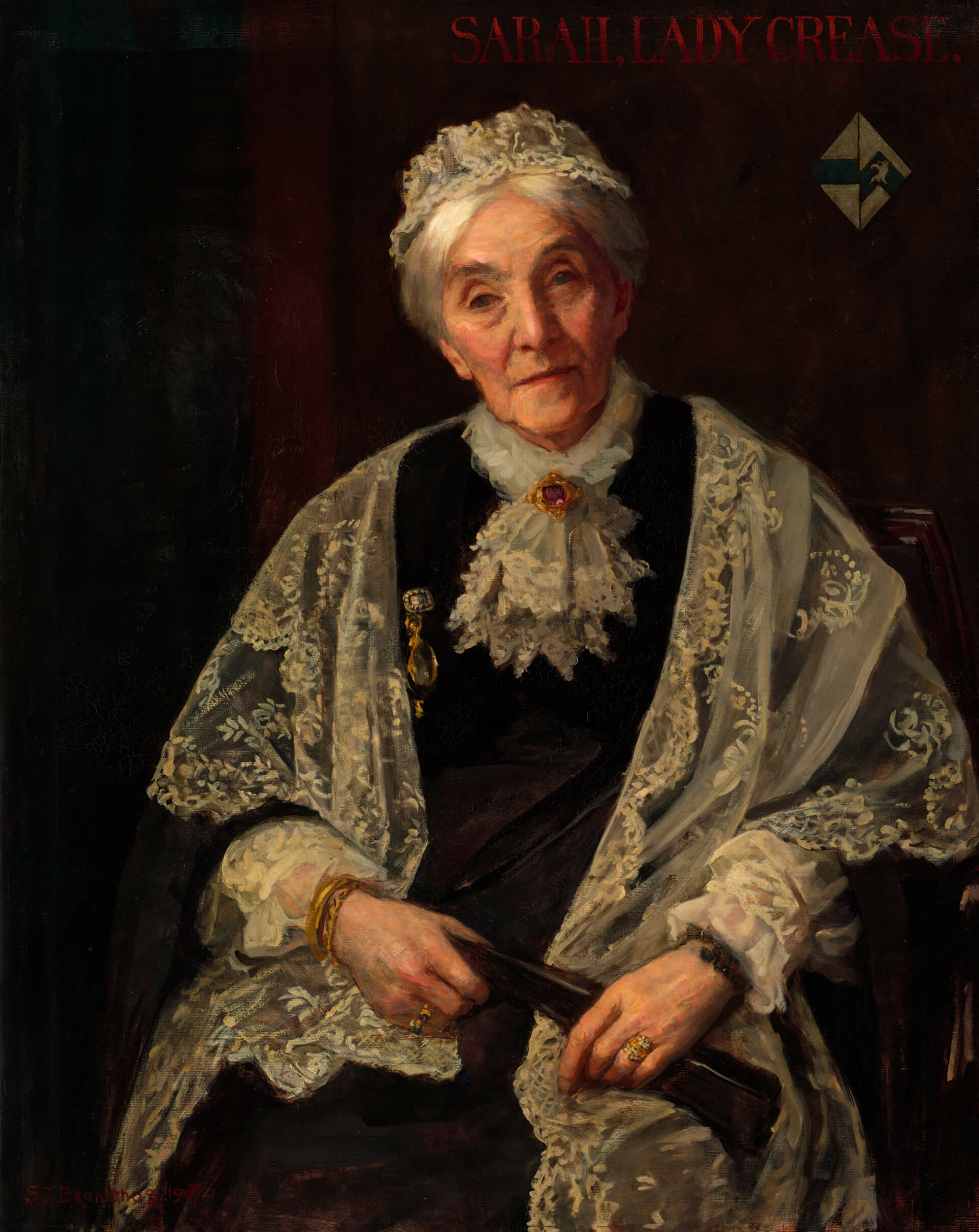
Sarah, Lady Crease, oil on canvas, 1907 by Sophie Pemberton
Royal BC Museum, Victoria
She passed away in Victoria in 1959 at the age of ninety. Pemberton's career is remarkable for the opportunities she pursued and the obstacles she encountered. She trained in London and Paris, exhibited internationally, won recognition at the Académie Julian, and became an Associate of the Royal Canadian Academy of Arts. Today, Sophie Pemberton remains an important figure in the history of Canadian art, particularly in the story of women who pursued professional artistic careers at a time when that path was far from straightforward.
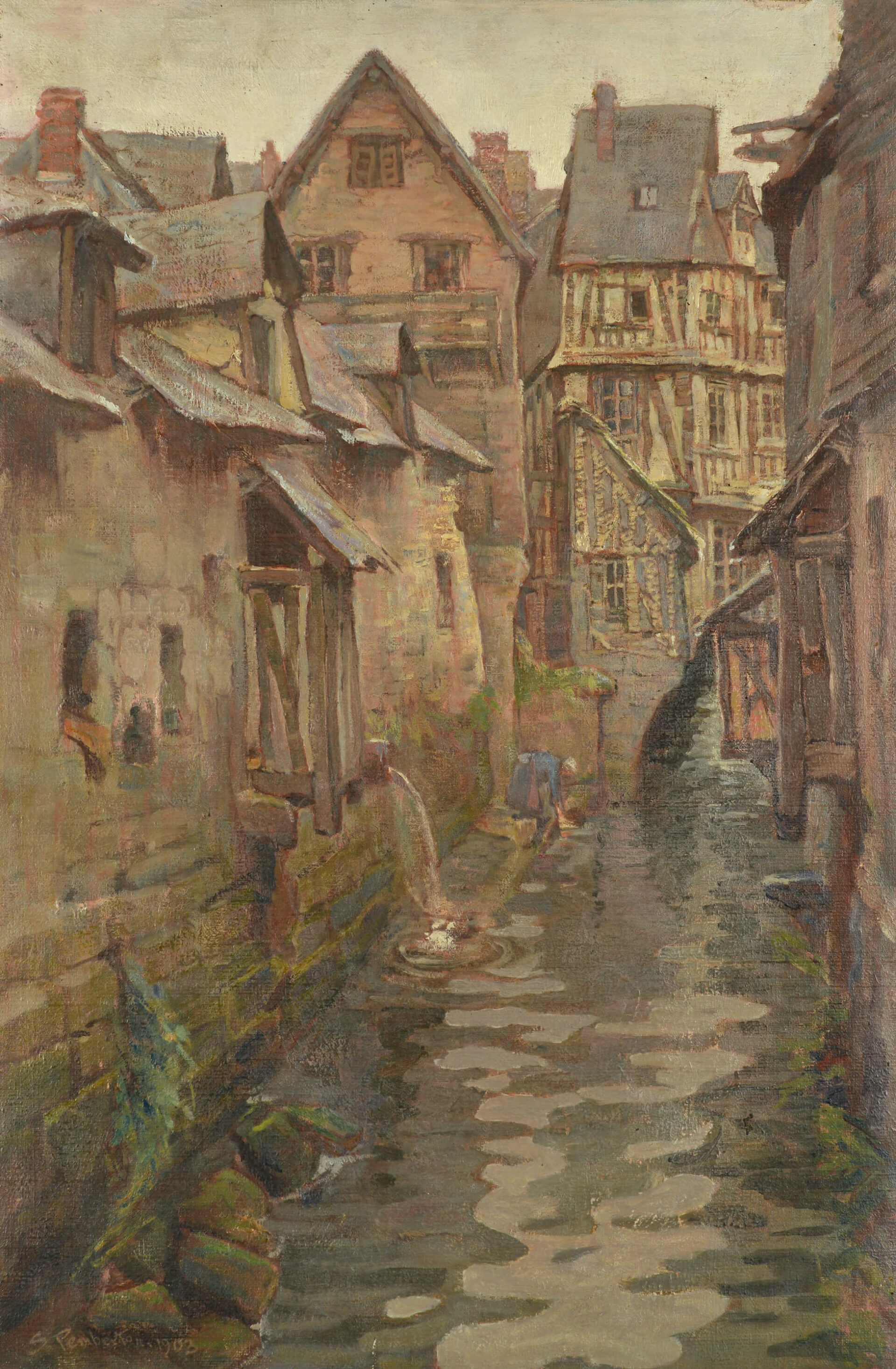
Caudebec-en-Caux, oil on canvas, 1903 by Sophie Pemberton
Art Gallery of Greater Victoria
Consignment at Rookleys
At Rookleys Canadian Art, we are actively seeking works by Sophie Pemberton for consignment, offering consignment rates far lower below what auction houses charge. If you have a piece by Sophie Pemberton to consign, please contact us at info@rookleys.com to discuss these opportunities further.

Life drawing of a male, charcoal on paper, 1893 by Sophie Pemberton
Royal BC Museum, Victoria
Bibliography
Atanassova, Katerina, ed. *Canada and Impressionism: New Horizons*. Ottawa: National Gallery of Canada; Stuttgart: Arnoldsche Art Publishers, 2019.
Bridge, Kathryn. *Sophie Pemberton: Life & Work*. Toronto: Art Canada Institute, 2023.
Finlay, K. A., ed. *A Women’s Place: Art and the Role of Women in the Cultural Formation of Victoria, BC, 1850s–1920s*. Victoria: Maltwood Art Museum and Gallery, 2004.
Graham, Colin. *Sophie Deane-Drummond*. Victoria: Art Gallery of Greater Victoria, 1967.
Huneault, Kristina. *I’m Not Myself at All: Women, Art, and Subjectivity in Canada*. Montreal and Kingston: McGill-Queen’s University Press, 2018.
Huneault, Kristina. “Botanical Albums as Theoretical Objects: Sophie Pemberton and the Logic of Identity.” In *Flora’s Fieldworkers: Women and Botany in Nineteenth-Century Canada*, edited by Ann Shtier. Montreal and Kingston: McGill-Queen’s University Press, 2022.
Huneault, Kristina, and Janice Anderson, eds. *Rethinking Professionalism: Women and Art in Canada, 1850–1970*. Montreal and Kingston: McGill-Queen’s University Press, 2012.
Prakash, A. K. *Independent Spirit: Early Canadian Women Artists*. Richmond Hill: Firefly Books, 2008.
Thom, Ian. *Art BC: Masterworks from British Columbia*. Vancouver: Douglas & McIntyre, 2000.
Tippett, Maria. *By a Lady: Celebrating More Than Three Centuries of Art by Canadian Women*. Toronto: Viking Press, 1993.
Tuele, Nicholas Craig. *Sophia Theresa Pemberton, 1869–1959*. Victoria: Art Gallery of Greater Victoria, 1978.
Art Canada Institute. “Sophie Pemberton: Life & Work.” *Art Canada Institute*.