Coburn was born in Upper Melbourne, Quebec, on March 18, 1871. His artistic skill was recognized early, especially by the poet William Henry Drummond, who played a crucial role in guiding the young artist toward formal training. Following his advice, Coburn began his studies at the Council of Arts and Manufactures School in Montreal before moving on to New York’s Carl Hecker School of Art. Ambitious and exceptionally dedicated, he continued his education at the age of 19 in Europe studying at the Royal Academy in Berlin. Coburn received rigorous training in draughtsmanship under Erhentraut and Skarbina in Germany, where he learned to render the human form with near-photographic accuracy. Later in Paris, he was among the select students who worked directly in Jean-Léon Gérôme’s studio. During his time there, he encountered the emerging ideas of Impressionism and immersed himself in the vibrant café and dance-hall culture shared by fellow Canadian art students and artists such as Toulouse-Lautrec.

After, he studied at the Slade School in London with Henry Tonks, where Tonk’s approach to painting differed drastically from that of Jean-Léon Gérôme. He was encouraged to interpret his subjects rather than try and paint their exact likeness. While in London, Coburn began producing illustrations for publications such as the London Sporting and Dramatic News and The London News.
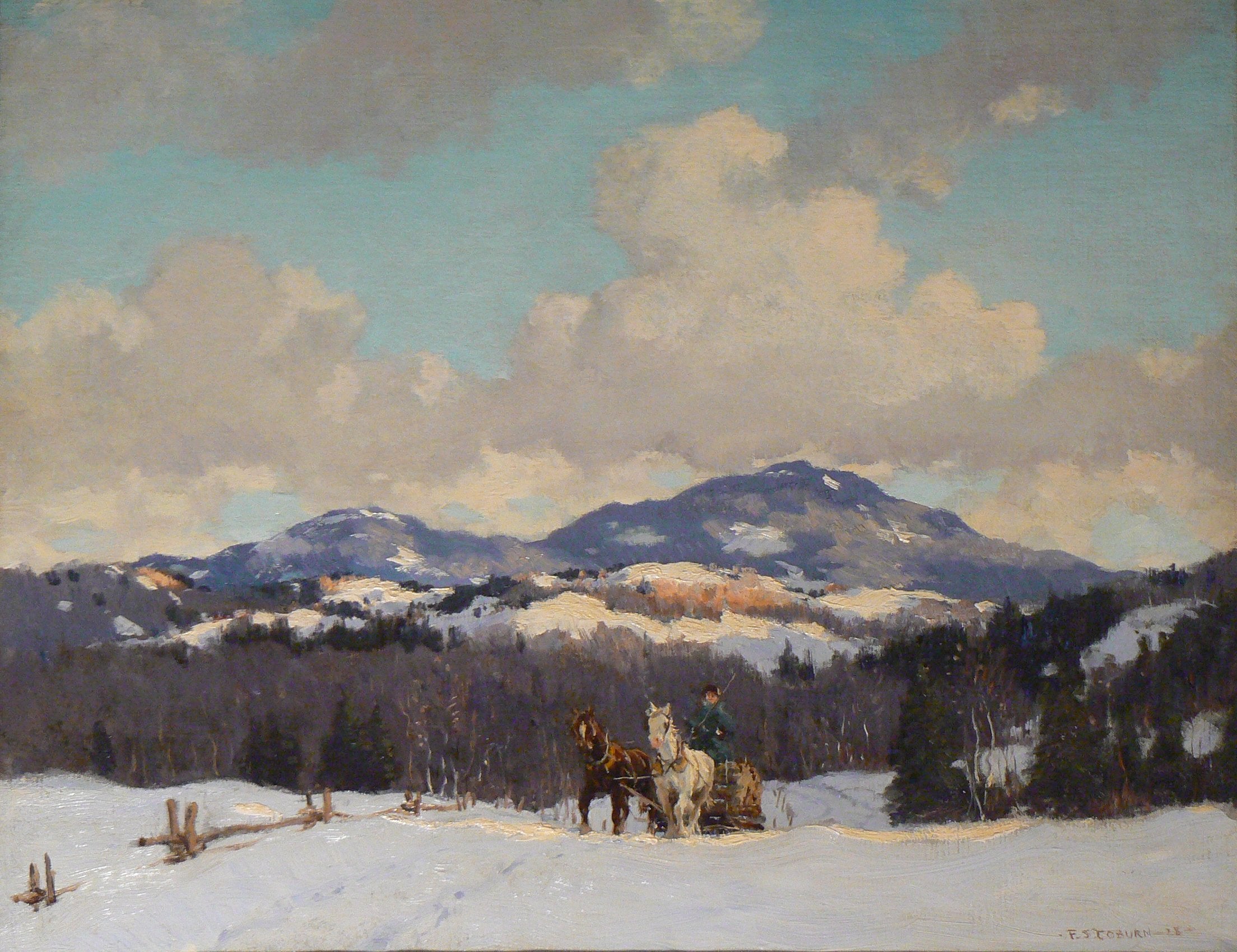 Logging, 1928 by Frederick Coburn Simpson
His growing interest in the Hague School then led him to Holland, where encounters with the Maris brothers and J.H. de Weissenbruch left a lasting mark on his work. While in the Netherlands, he explored new color palettes and depicted the region’s thatched cottages, serene livestock, windswept shores, windmills, and interiors, capturing both the landscape and the spirit of its inhabitants. During his time abroad, Coburn also became fluent in French, German, Dutch, and Flemish.
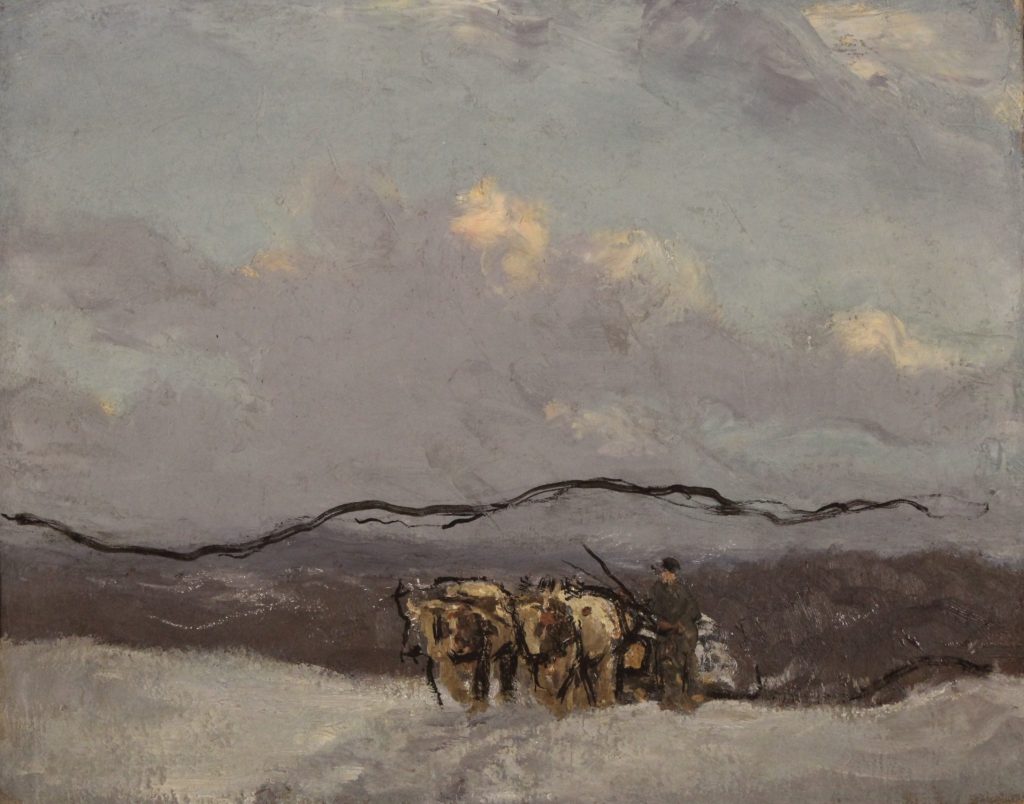
Oxen Winter, oil on canvas by Frederick Simpson Coburn
His true breakthrough came in 1896, at the age of 25, when he illustrated William Henry Drummond’s The Habitant, a poetry book about rural Quebec. To authentically portray the rural Quebec life, Coburn lived among habitant families, sketching their daily activities and capturing the character of the people he knew from childhood. The success of The Habitant launched him into an international career as an illustrator, leading to collaborations with major authors including Charles Dickens, Edgar Allan Poe, Alfred Lord Tennyson, Washington Irving, and Louis Fréchette. His illustrations had an expressive, tightly controlled technique rooted in his European training, and during this period he worked in a darker, more traditional palette.
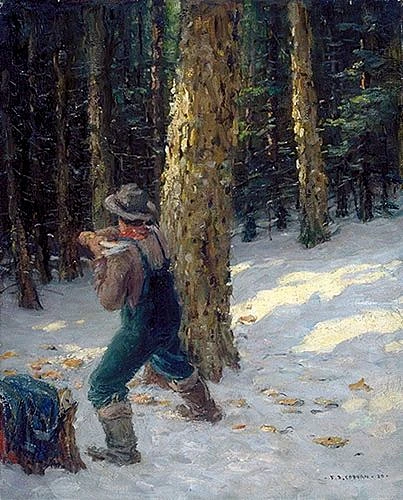
Lumberjack in Winter, 1920, oil on canvas by Frederick Simpson Coburn
In 1913, after more than two decades in Europe, Coburn returned permanently to Canada. The following year was a turning point in his painting when he began sketching with Maurice Cullen, one of the leading figures of Canadian Impressionism. Working with Maurice Cullen transformed Coburn’s approach to colour and light. He abandoned the dark tones of his illustration work and embraced the changing light of the Canadian landscape. What followed was the development of the iconic subject matter that remains most associated with his name: winter scenes of horses and oxen pulling sleds along snowy paths, illuminated by the light of early morning or late afternoon. These paintings captured something uniquely Canadian at a moment when the country was beginning to establish its own artistic identity.

Hauling timber in winter on Quebec roads, 1923, oil on canvas by Frederick Simpson Coburn
Coburn exhibited widely throughout his career. In 1928 his paintings appeared at the Imperial Gallery of Art Exhibition in London, and in 1929 he received the Art Association of Montreal’s Jessie Dow Prize. A special exhibition of his Drummond illustrations was held at the Arts Club of Montreal in 1932, and in 1938 his paintings were included in the Tate Gallery’s landmark exhibition A Century of Canadian Art in London. He became a full member of the Royal Canadian Academy in 1941 and received an honorary Doctor of Civil Law degree from Bishop’s University in 1936. His work entered major public collections across Canada, the United Kingdom, Europe, Japan, Australia, and the United States. The Musée des beaux-arts de Sherbrooke in Quebec houses the most extensive permanent collection of Coburn’s work.

Coburn’s life and work often overlapped. While studying in Antwerp, he met the Belgian artist Malvina Scheepers, who later became his wife. The two eventually settled in Upper Melbourne, and together they established a home and studio in Upper Melbourne along with a pied-à-terre in Montreal. After Malvina’s sudden death in 1933, he was greif strucken. Encouraged by his friend and fellow artist Edmond Dyonnet, Coburn met Carlotta, a talented dancer and model. Their 27-year relationship inspired a new chapter in his artwork, where he would paint her in the dramatic dance costumes she designed for the Tango and other performances. During this period he even learned to dance himself, and, together with Carlotta’s dance partner Alvarez he helped establish a dance studio in Montreal.

Stop in the late afternoon, 1933, oil on canvas by Frederick Simpson Coburn
Frederick Simpson Coburn died peacefully in his Upper Melbourne studio on May 26, 1960, at the age of 89. He started as a European-trained illustrator and became one of Canada’s most beloved painters of rural Quebec. Coburn is remembered today as one of Canada’s finest genre painters, an artist whose work continues to define a distinctly Canadian sense of place.
Consignment at Rookleys
At Rookleys Canadian Art, we are actively seeking works by Frederick Simpson Coburn for consignment, offering consignment rates far lower below what auction houses charge. If you have a painting by Frederick Simpson Coburn to consign, please contact us at info@rookleys.com to discuss these opportunities further.
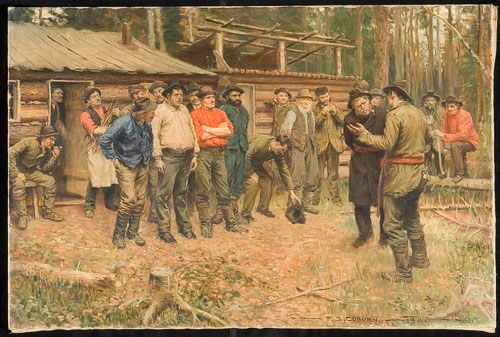
Construction site scene, 1900, oil on canvas by Frederick Simpson Coburn
Canadian Encyclopedia. “Frederick Simpson Coburn.” The Canadian Encyclopedia. Last modified March 4, 2024. https://thecanadianencyclopedia.ca/en/article/frederick-simpson-coburn
Musée national des beaux-arts du Québec. “Coburn, Frederick Simpson.” MNBAQ Collection. https://www.mnbaq.org/en/artists/coburn-frederick-simpson
Musée des beaux-arts de Sherbrooke. “Dans l’atelier de Frederick Simpson Coburn.” MBAS. https://mbas.qc.ca/dans-latelier-de-frederick-simpson-coburn/
Wikipedia contributors. “F. S. Coburn.” Wikipedia. Last modified November 20, 2025. https://en.wikipedia.org/wiki/F._S._Coburn
F.S. Coburn. F.S. Coburn Official Website. https://fscoburn.com/