

Maud Lewis (March 7, 1903 – July 30, 1970) remains one of the most beloved figures in Canadian art and one of the best-known Canadian folk artists of the 20th century. Born Maud Kathleen Dowley in South Ohio, Nova Scotia, she became famous for her small, brightly coloured paintings of rural Nova Scotia life. Her cheerful images of black cats, oxen, sleigh rides, coastal villages, flowers, deer, and birds have made Maud Lewis paintings instantly recognisable to collectors and admirers of Canadian folk art. Interest in her life and work expanded even further after the 2016 film Maudie, starring Sally Hawkins and Ethan Hawke, introduced her story to an international audience.

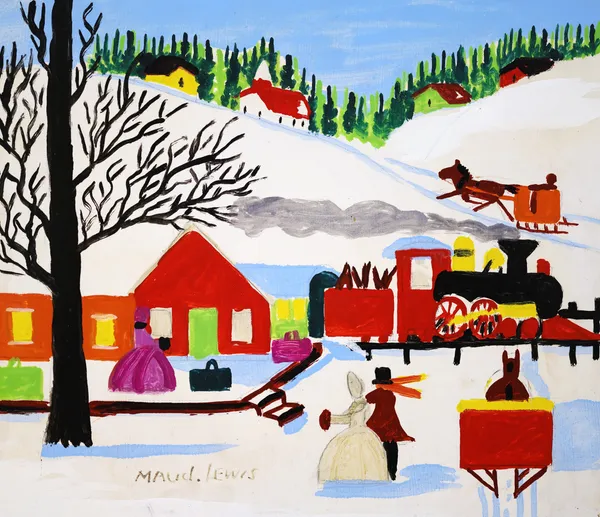
Maud Lewis; Train Station
Maud Lewis drew much of her inspiration from the people, animals, and landscapes around Yarmouth and Digby County, Nova Scotia. Although she lived with physical challenges throughout her life, including the effects of rheumatoid arthritis, she created paintings filled with warmth, optimism, and delight. Rather than focusing on hardship, Maud Lewis art celebrates the beauty of ordinary rural life through bold colour, simplified forms, and a deeply personal sense of joy. Her work stands apart for its innocence, clarity, and enduring emotional appeal.
In 1938, Maud answered an advertisement placed by Everett Lewis, a fish peddler from Marshalltown, Nova Scotia, who was looking for a housekeeper. Their relationship soon changed, and Maud became Everett’s wife. The couple lived in poverty in a tiny one-room house without electricity or plumbing, yet it was there that Maud Lewis built one of the most distinctive careers in Canadian folk painting. She transformed not only small boards and household objects into works of art, but also her home itself, painting its doors, walls, and windows with flowers, birds, and other colourful imagery that reflected her unique vision.

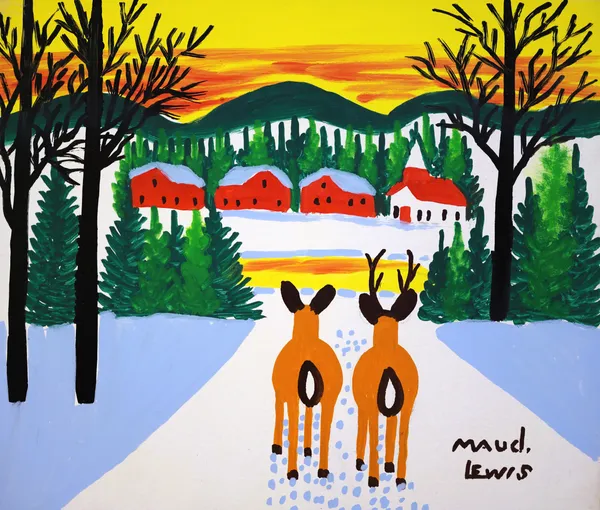
Maud Lewis; Two Deer
Maud Lewis began by making hand-drawn Christmas cards, a practice she learned from her mother, and gradually expanded into painted boards, postcards, clamshells, dustpans, and cookie tins. She often worked with whatever materials she could find, using house paint and other readily available supplies. This resourcefulness became part of her artistic identity. The painted exterior and interior of her Marshalltown house also helped attract the attention of passing travellers, turning her home into a kind of living advertisement for her art. What began as humble local production grew into a body of work now celebrated as an essential part of Nova Scotia art and Canadian cultural history.
National recognition came relatively late in Maud Lewis’s life. In 1964, a feature in Star Weekly brought her work to a wider audience, and in 1965 she was featured in the CBC television programme Telescope. These introductions helped establish her as a significant Canadian artist, even though her paintings remained modest in size and price during her lifetime. Today, original Maud Lewis paintings are highly sought after, and works such as A Family Outing, A View of Sandy Cove, and Portrait of Eddie Barnes and Ed Murphy, Lobster Fishermen have helped secure her reputation in the history of Canadian folk art.

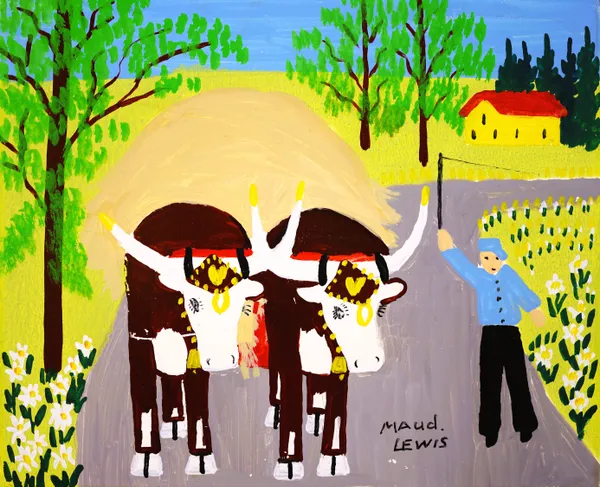
Maud Lewis; Two Oxen
What continues to make Maud Lewis so compelling is the contrast between her difficult circumstances and the uplifting world she created in paint. Her scenes are full of movement, pattern, and colour, often combining winter landscapes with unexpected warmth and decorative charm. Trees bloom, animals seem almost to smile, and the Nova Scotia countryside becomes a place of happiness and possibility. That quality has led many viewers to compare her to Grandma Moses, yet Maud Lewis remains entirely original, rooted in her own experiences and in the visual character of rural Nova Scotia.
The legacy of Maud Lewis extends far beyond her paintings. Her tiny painted house was saved through preservation efforts and is now one of the most important attractions at the Art Gallery of Nova Scotia, where it stands as a lasting monument to her life and creativity. A steel memorial sculpture inspired by the house also stands at the original Marshalltown site. In 2020, Canada Post honoured her again with three Maud Lewis stamps, including the famous Winter Sleigh Ride, confirming her lasting place in Canadian visual culture.

Maud Lewis; Horse Drawn Sleighs and Covered Bridge
Today, Maud Lewis is remembered not only as a Nova Scotia artist, but as a national cultural icon whose paintings continue to bring joy to new generations. Her work captures the spirit of folk art at its most direct and heartfelt: personal, accessible, and unmistakably Canadian. For collectors, museums, and admirers of Canadian folk art, Maud Lewis remains a central figure whose paintings embody resilience, imagination, and an enduring love of place.