
Christopher Pratt (1935–2022) was one of Canada’s most respected painters and printmakers, known for his precise, carefully organized depictions of Newfoundland landscapes, architecture, and everyday life. He was born in St. John’s, Newfoundland, and spent much of his youth exploring the Bay Roberts and St. Mary’s Bay which influenced his artistic works.
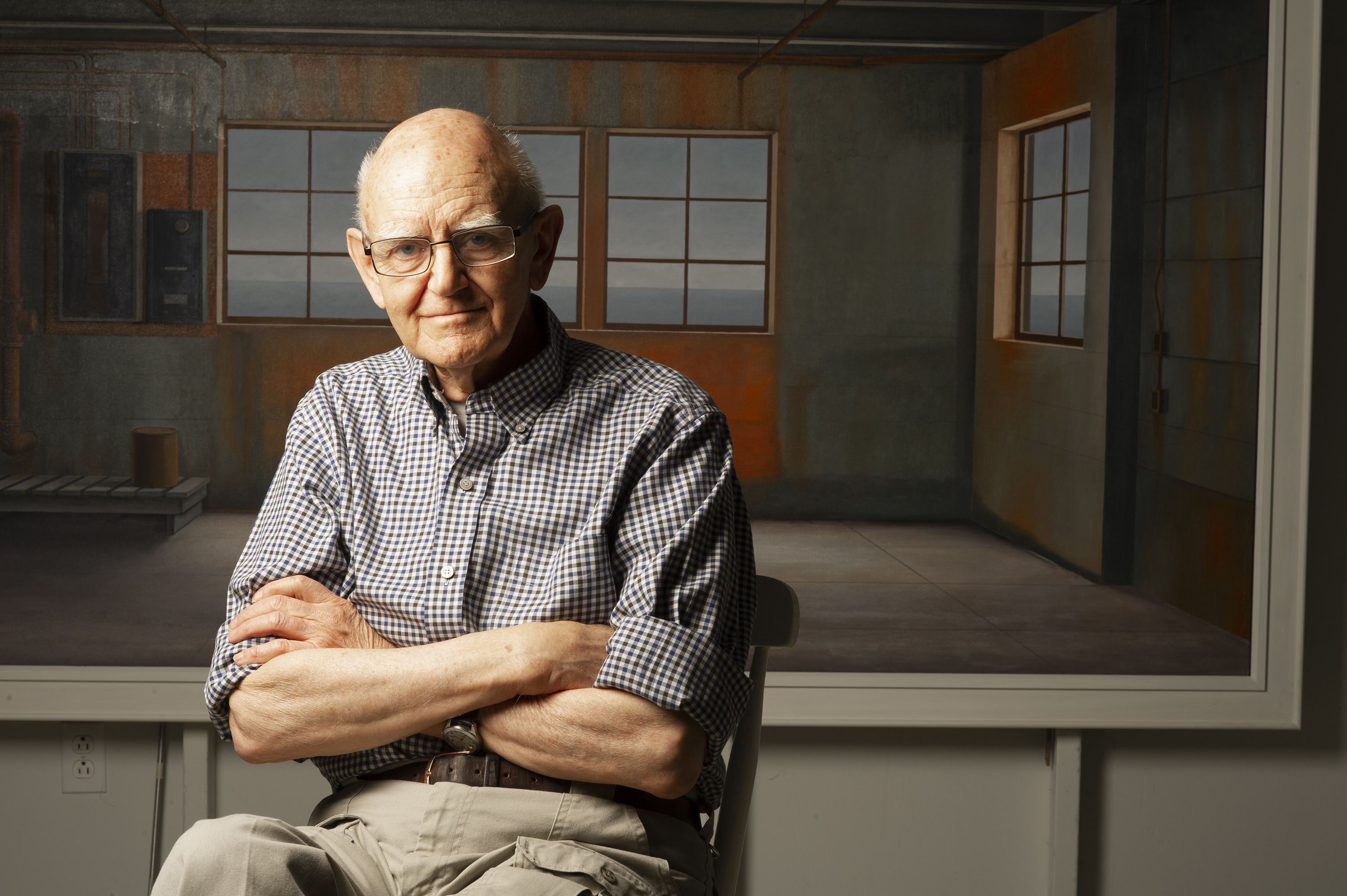
Christopher Pratt sitting in front of his painting "Argentia Interior: The Ruins of Fort McAndrew"
Pratt began painting watercolours in 1952 and soon gained early recognition when his work Shed in a Storm won the provincial Arts and Letters Competition. Initially pursuing studies outside the arts, he enrolled at Memorial University in pre-engineering, and later studied pre-medicine at Mount Allison University. It was at Mount Allison that he discovered his passion for painting, encouraged by instructors Alex Colville and Lawren P. Harris. During this period, he also met fellow student and future wife, Mary Pratt, who would go on to become one of Canada’s most acclaimed painters of luminous still lifes.

From 1957 to 1959, the couple studied at the Glasgow School of Art in Scotland, returning in 1959 to complete their Bachelor of Fine Arts degrees at Mount Allison in 1961. Pratt briefly worked as curator at the newly opened Memorial University Art Gallery (now The Rooms) before dedicating himself fully to painting.

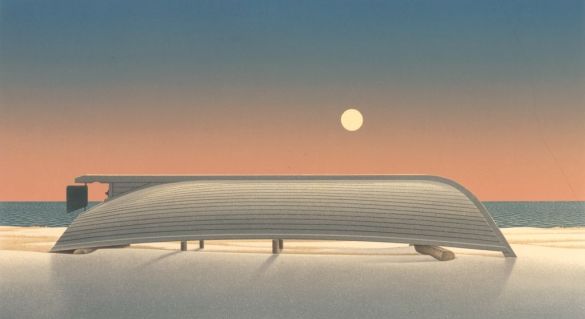
Pratt moved with his family to Salmonier, Newfoundland, in 1963, where he focused on creating carefully structured, precise paintings and prints. His work often has flattened surfaces, frontal compositions, and carefully organized detail, portraying everyday Newfoundland scenes as timeless, archetypal images. His art often included landscapes, roadways, boats, architecture, interior spaces, and the human figure, always attentive to light, both natural and artificial, which was a concern influenced by seeing Edward Hopper’s work in the 1970s. While not overtly political, Pratt’s art records the changes and modernization occurring in Newfoundland, as seen in works like Deer Lake: Junction Brook Memorial (1999).
Over his career, Pratt exhibited widely across Canada and internationally, including retrospectives at the Vancouver Art Gallery (1985) and the National Gallery of Canada (2005). His work is included in numerous collections such as the National Gallery of Canada, Art Gallery of Ontario, Vancouver Art Gallery, Mount Allison University, and The Rooms.

Pratt received numerous awards during his lifetime. In 1965, he became an Associate of the Royal Canadian Academy of Arts and a member of the Canadian Society of Graphic Art. He was appointed Officer of the Order of Canada in 1973 and elevated to Companion in 1983. In 1980, he designed the provincial flag of Newfoundland and Labrador.

After the Cold War: Argentia Approach, 2008, oil on canvas by Christopher Pratt
Pratt’s partnership with Mary Pratt was also a significant influence on Canadian art. Mary became one of the country’s foremost painters, known for her vivid, hyper-realistic still lifes, and together they created a creative environment that nurtured both their careers and left a lasting impact on Newfoundland’s artistic landscape.
Christopher Pratt continued to live and work in St. Mary’s Bay until his death in June 2022, leaving a legacy of precise, contemplative art that celebrates the beauty and ordinariness of life in Newfoundland.
Art Canada Institute. Christopher Pratt. Toronto: Art Canada Institute, 2018. https://www.aci-iac.ca/art-books/christopher-pratt/
Heritage Newfoundland and Labrador. “Christopher Pratt.” https://www.heritage.nf.ca/articles/arts/christopher-pratt.php
National Gallery of Canada. “Christopher Pratt.” https://www.gallery.ca/collection/artist/christopher-pratt
The Canadian Encyclopedia. “Christopher Pratt.” https://www.thecanadianencyclopedia.ca/en/article/christopher-pratt
The Rooms Provincial Art Gallery. “Christopher Pratt.” https://www.therooms.ca/