
David Alexander Colville was a Canadian painter and printmaker whose work blended realism with a subtle, almost magical sense of everyday life. Born in Toronto to Scottish immigrant parents, Colville moved with his family to St. Catharines, Niagara and then to Amherst, Nova Scotia, in 1929. From an early age, he showed a remarkable talent for drawing and painting, which led him to study at Mount Allison University from 1938 to 1942. There, he trained under Canadian Post-Impressionists such as Stanley Royle and Sarah Hart, graduating with a Bachelor of Fine Arts.
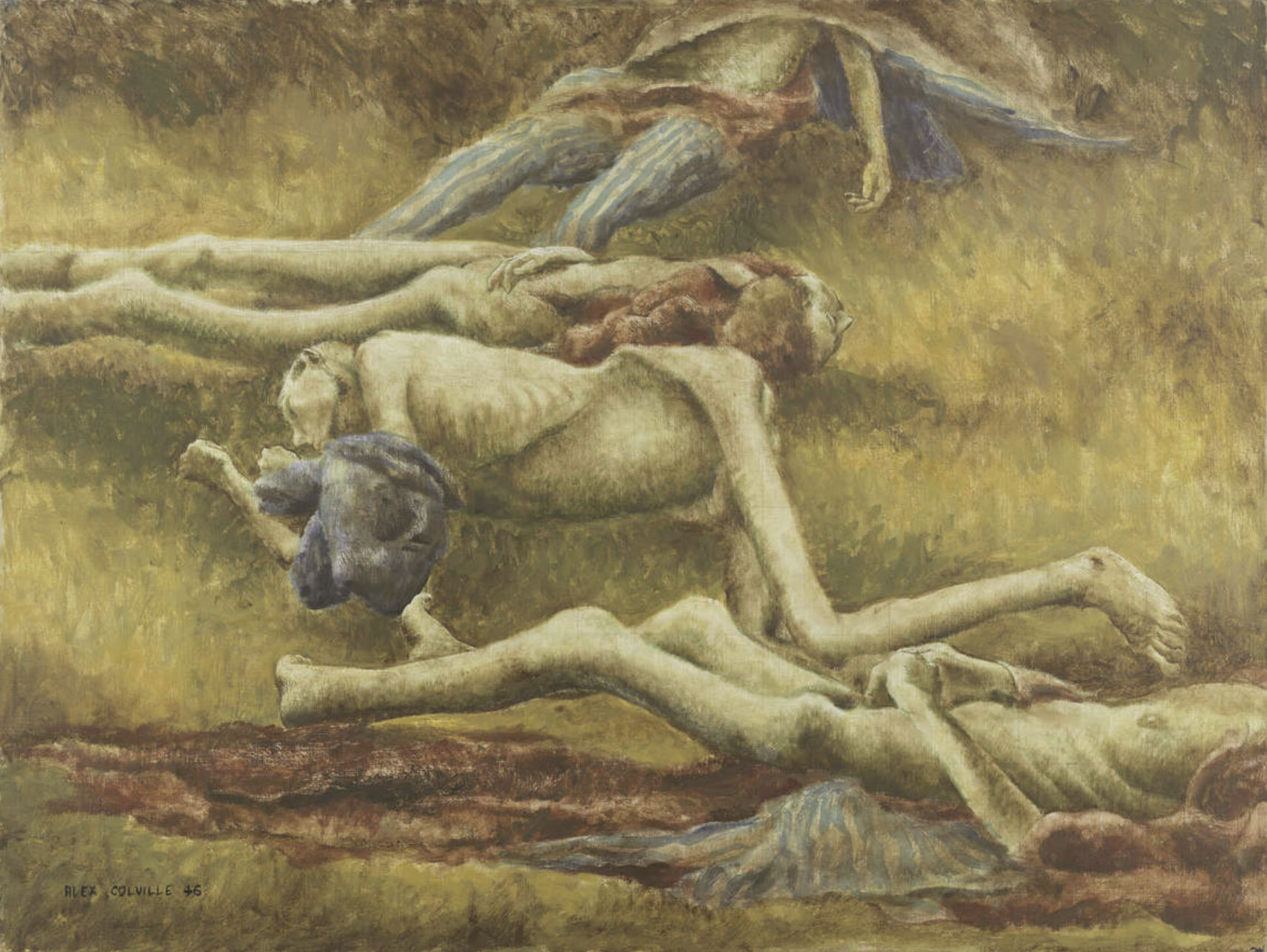
During World War II, Colville enlisted in the Canadian Army and rose to the rank of lieutenant. In 1944, he was appointed an Official Canadian War Artist, documenting the European theatre with the 3rd Canadian Division. His wartime experiences took him to the Netherlands, Germany, and the Bergen-Belsen concentration camp, where he recorded scenes of liberation and the aftermath of atrocities. His painting Bodies in a Grave (1946), depicting emaciated corpses at Bergen-Belsen, remains a historically significant testament to the horrors he witnessed.
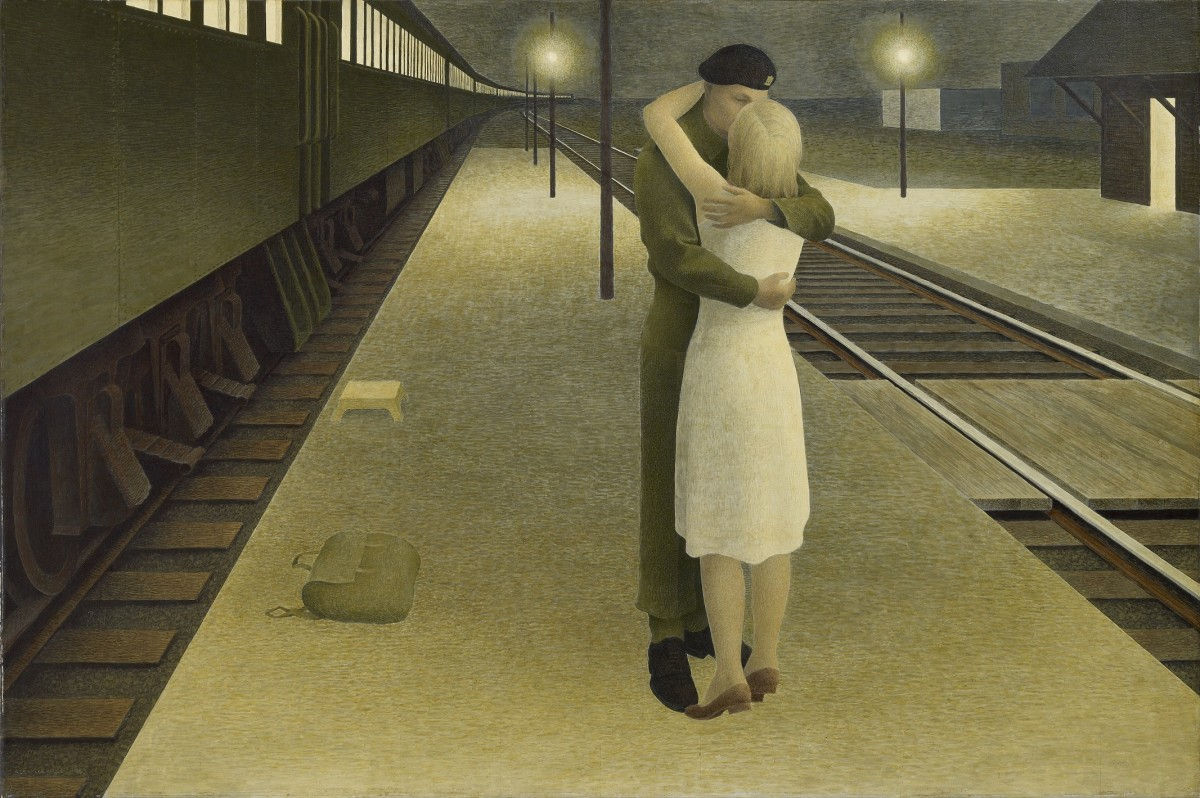
After the war, Colville returned to Mount Allison University, where he taught in the Fine Arts Department from 1946 to 1963. During this period, he became a mentor to a generation of Canadian artists, helping define Maritime Realism, a movement characterized by precise, structured compositions and a focus on the everyday aspects of life in the Maritime provinces. Among his students were notable figures such as Tom Forrestall, Christopher Pratt and Mary Pratt.

Colville’s own work is often associated with Magic Realism. Unlike the dramatic theatricality of surrealism, his paintings depict ordinary life imbued with a tension or poetic weight. He frequently used his family as models, particularly his wife Rhoda, painting routines, leisure, and the landscapes of Nova Scotia’s Annapolis Valley. His compositions are geometrically precise, planned through sketches and studies, and executed on primed wooden panels with layers of thinned paint sealed with transparent lacquer which was a painstaking process that could take months.

Even as abstraction and other modernist movements dominated the mid-20th century, Colville remained committed to his meticulous realism. As Robert Fulford wrote in Saturday Night, “Behind his words, as behind his art, you can sense elaborate webs of thought. And, also like his paintings, he stands quite alone, beyond category.”

After the period at Mount Allison, Alex Colville left teaching in 1963 to devote himself entirely to painting and printmaking. He continued to live and work in Sackville, New Brunswick, in the house that would later be named Colville House, now a museum and gallery under the Owens Art Gallery at Mount Allison.
During these years, Colville’s reputation grew nationally and internationally. In 1966, he represented Canada at the Venice Biennale, and in 1967 he was made an Officer of the Order of Canada, later promoted to Companion in 1982, the highest rank of the order. His work remained centered on his immediate surroundings, with his family and the landscapes of the Annapolis Valley serving as recurring subjects.
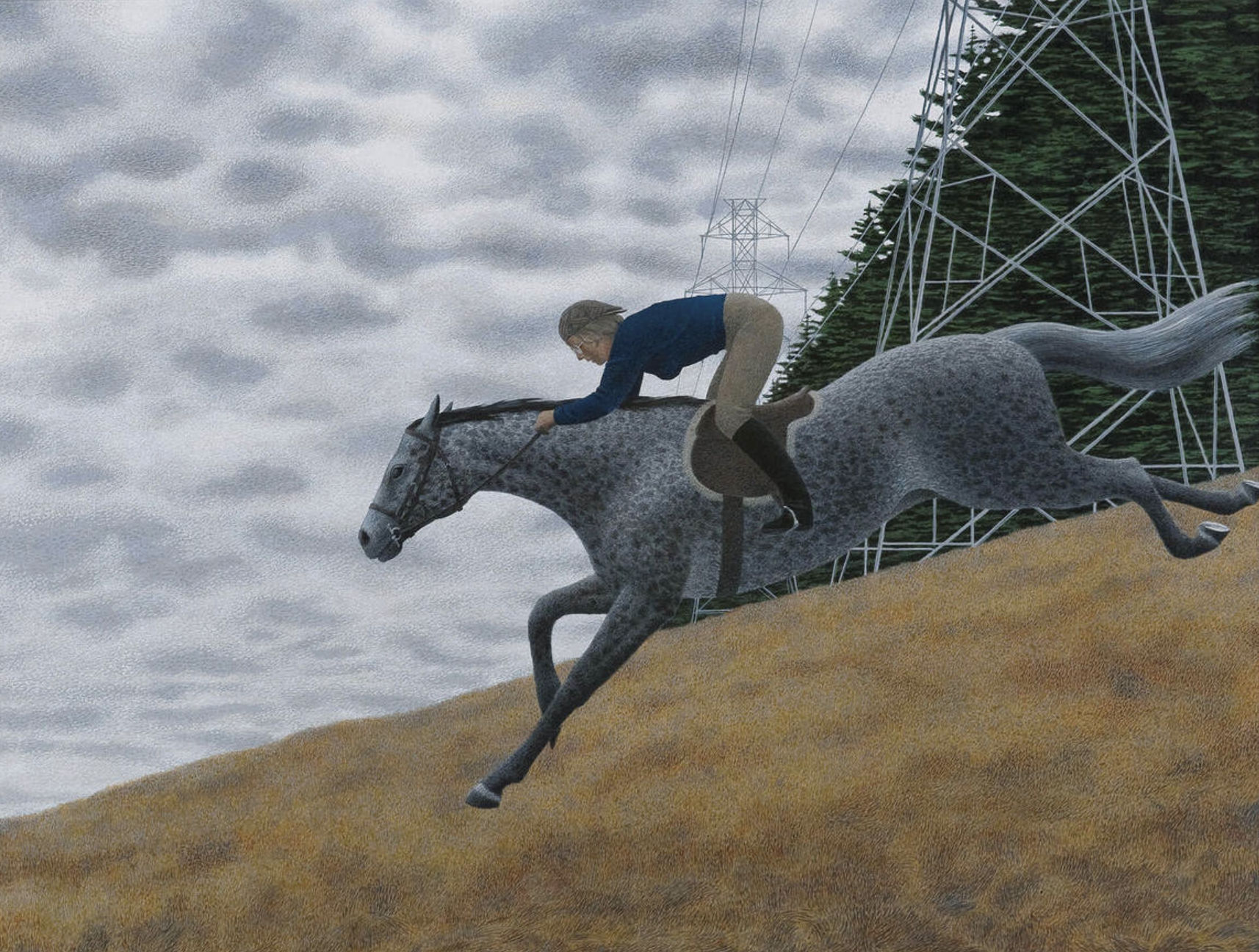
Colville continued to exhibit widely, including major retrospectives organized by the Art Gallery of Ontario and shows at institutions like the Tate Gallery in London, the Museum of Modern Art in New York, and the Musée National d’Art Moderne in Paris. His style matured, maintaining the meticulous geometry and compositional precision of his earlier work while deepening the psychological tension and poetic ambiguity in his paintings.
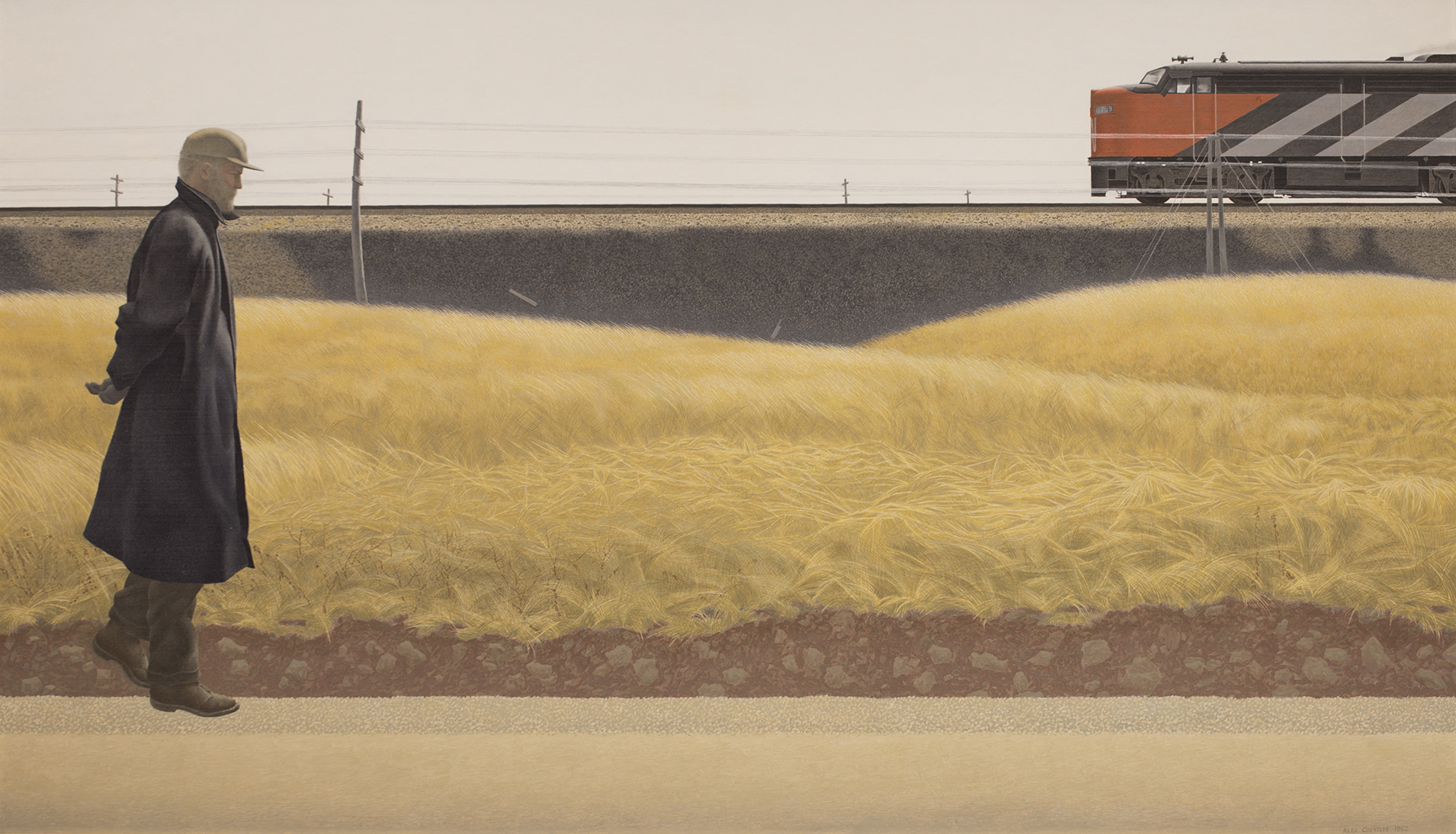
Alex Colville died peacefully at his home in Wolfville, Nova Scotia, on July 16, 2013, at the age of 92. His legacy endures not only in his precise, haunting images but also in the artists he taught, the collections that preserve his work, and the influence he had on Canadian art.
Consignment at Rookleys
At Rookleys Canadian Art, we are actively seeking works by Alex Colville for consignment, offering consignment rates far lower below what auction houses charge. If you have a painting by Alex Colville to consign, please contact us at info@rookleys.com to discuss these opportunities further.
Bibliography
Art Canada Institute. Alex Colville. Toronto: Art Canada Institute, 2017. https://aci‑iac.ca/art‑books/alex‑colville/
Art Canada Institute. “Life & Work.” Alex Colville: Life & Work. Art Canada Institute. https://aci‑iac.ca/art‑books/alex‑colville/
Art Canada Institute. “Significance & Critical Issues.” Alex Colville. Art Canada Institute. https://aci‑iac.ca/art‑books/alex‑colville/significance‑and‑critical‑issues/
Art Canada Institute. “Style & Technique.” Alex Colville. Art Canada Institute. https://aci‑iac.ca/art‑books/alex‑colville/style‑and‑technique/
Art Canada Institute. “Sources & Resources.” Alex Colville. Art Canada Institute. https://aci‑iac.ca/art‑books/alex‑colville/sources‑and‑resources/
“Alex Colville | Biography, Paintings & Themes.” Encyclopaedia Britannica. https://www.britannica.com/biography/Alex‑Colville
“Alex Colville | Official site of Canadian artist Alex Colville.” https://alexcolville.ca/