
"It can't just be a painting of something, it has to be a painting that is something. A painting has to acquire a life of its own." - Mary Pratt
Mary Pratt had an early commitment to art, beginning painting lessons as a child before enrolling at Mount Allison University, where she studied under influential figures including Alex Colville, Ted Pulford, and Lawren P. Harris. At Mount Allison she also met fellow artist Christopher Pratt, whom she later married. The precision, discipline, and moral seriousness associated with the so-called “Mount Allison realists” would remain central to her practice, though Pratt applied these values to a personal subject matter.

By the late 1960s, Pratt had developed the themes that would define her career. Drawing from her immediate surroundings, she painted jars of jelly, wrapped meats, aluminum foil, apples, brown paper bags, and carefully arranged tabletops. Using photographic slides projected onto masonite or canvas, Pratt achieved an exacting realism, yet her paintings are never mechanical. Light becomes sensuous and tactile and surfaces glow with warmth.

Central to Pratt’s work was her sustained investigation of light, how it falls across objects, penetrates translucent surfaces, and alters emotional perception. Jelly jars refract illumination like stained glass; aluminum foil becomes sculptural; flesh, fabric, and food are rendered with equal care. This attention to light is expressive, revealing vulnerability, intimacy, and the labor in domestic life.

Throughout the 1970s and 1980s, Pratt broadened her imagery to include portraits, wedding scenes, and images of fire, which were interpreted as metaphors for sacrifice and transformation. These works coincided with major personal changes, including her divorce.

Pratt worked across various medias, including oil, pastel, and coloured pencil, maintaining technical rigor while adapting her approach to suit each subject.
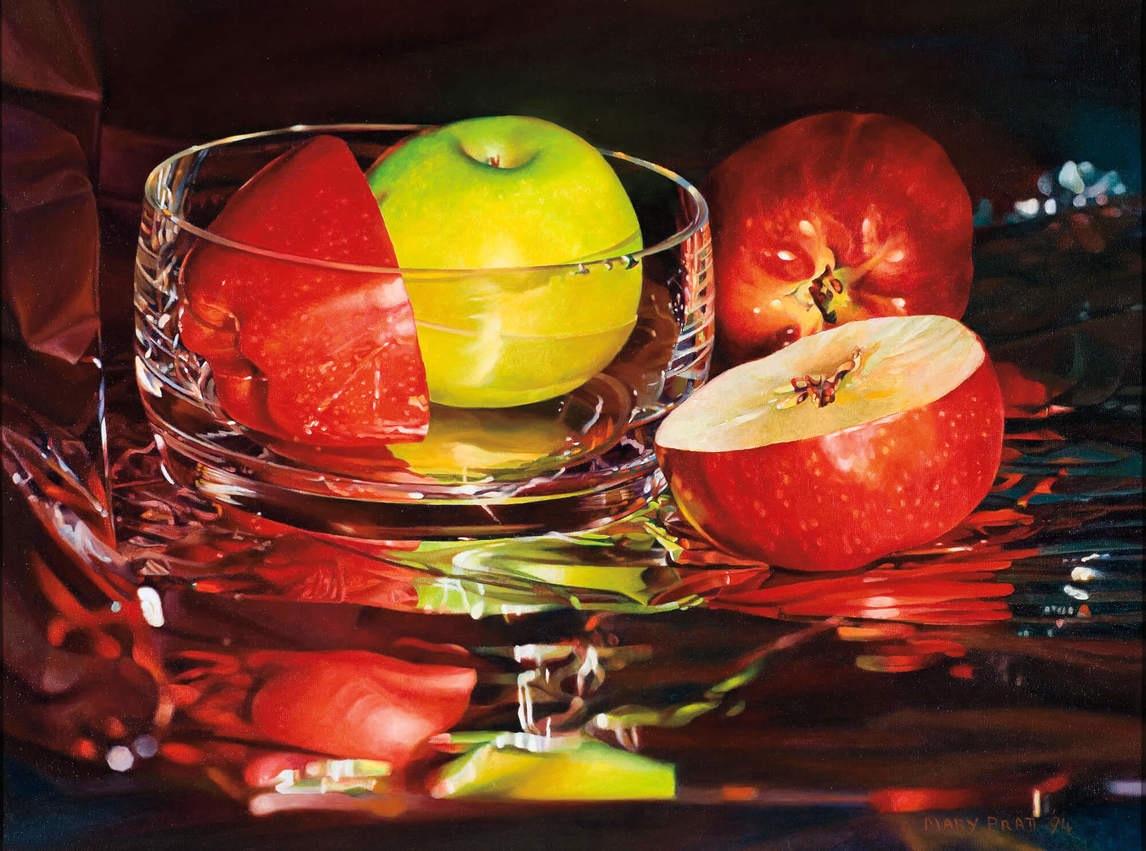
Pratt’s influence extends well beyond her own generation, particularly in the way she legitimized domestic subject matter as a site of serious artistic inquiry. At a time when realism was often dismissed as conservative or illustrative, Pratt demonstrated that close observation of everyday life, especially the private, often invisible labour of the home, could be intellectually rigorous, complex, and innovative. Her work has been especially influential for female painters, including those working in Atlantic Canada, who found in Pratt’s practice a model for pursuing realism without nostalgia and personal experience without sentimentality. By insisting that domestic scenes could carry conceptual weight, Pratt helped redefine realism as a contemporary and even radical position, opening space for subsequent artists to engage lived experience as a valid and powerful subject.

Pratt’s work has been widely exhibited and collected by major institutions across Canada. Her paintings are held by the National Gallery of Canada, the Art Gallery of Nova Scotia, and numerous public collections. The landmark touring exhibition The Art of Mary Pratt: The Substance of Light (1995), organized by the Beaverbrook Art Gallery, brought national attention to her achievements and was accompanied by an award-winning catalogue. Later retrospectives, including Mary Pratt: This Little Painting at the National Gallery of Canada (2015–2016), reaffirmed her importance as one of Canada’s most compelling realist painters.

Beyond the studio, Pratt played a significant role in Canadian cultural life. She served on the Canada Council, advised on the development of arts education in Newfoundland, and wrote thoughtfully about art and visual culture for publications such as The Globe and Mail. Her contributions were recognized with numerous honours, including appointment as a Companion of the Order of Canada, the Molson Prize, multiple honorary degrees, and a Canada Post stamp series celebrating her work.
Mary Pratt passed away in St. John’s, Newfoundland, in 2018. Her paintings continue to resonate for their technical mastery and attention to the lived experience of everyday life. In elevating the domestic to the level of the sublime, Pratt reshaped Canadian realism and expanded the possibilities of what, expanded the possibilities of what—and whose lives, particularly women’s domestic lives—could be considered worthy of sustained artistic attention.

Green Grapes and Wedding Presents with Half a Cantaloupe, 1993
oil on canvas by Mary Pratt
Consignment at Rookleys
At Rookleys Canadian Art, we are actively seeking works by Mary Pratt for consignment, offering consignment rates far lower below what auction houses charge. If you have a painting by Mary Pratt to consign, please contact us at info@rookleys.com to discuss these opportunities further.

Emmenthal Cheese in Saran, 1993, oil on linen by Mary Pratt
Sources
Art Canada Institute. Mary Pratt: Life & Work. Art Canada Institute.
Art Canada Institute. Mary Pratt: Style and Technique. Art Canada Institute
National Gallery of Canada. Mary Pratt.