
Born on October 8, 1859, in Hamilton, Ontario, Bruce was the son of William Bruce and Janet Blair. Encouraged by his parents, who were both musically and artistically inclined, Bruce showed early talent for painting. In his youth, he studied law at the Hamilton Collegiate Institute and then spent three years working in a handwriting academy run by his father, a gifted calligrapher and amateur watercolourist. Alongside this, he took painting lessons from his father, John Herbert Caddy, and Henry Martin, and briefly attended the Hamilton Art School in 1877. After three years of study in an architect’s office, he decided to pursue a career as a professional artist. In May 1881, he exhibited two oils and a watercolour with the Ontario Society of Artists, marking the beginning of his public career.


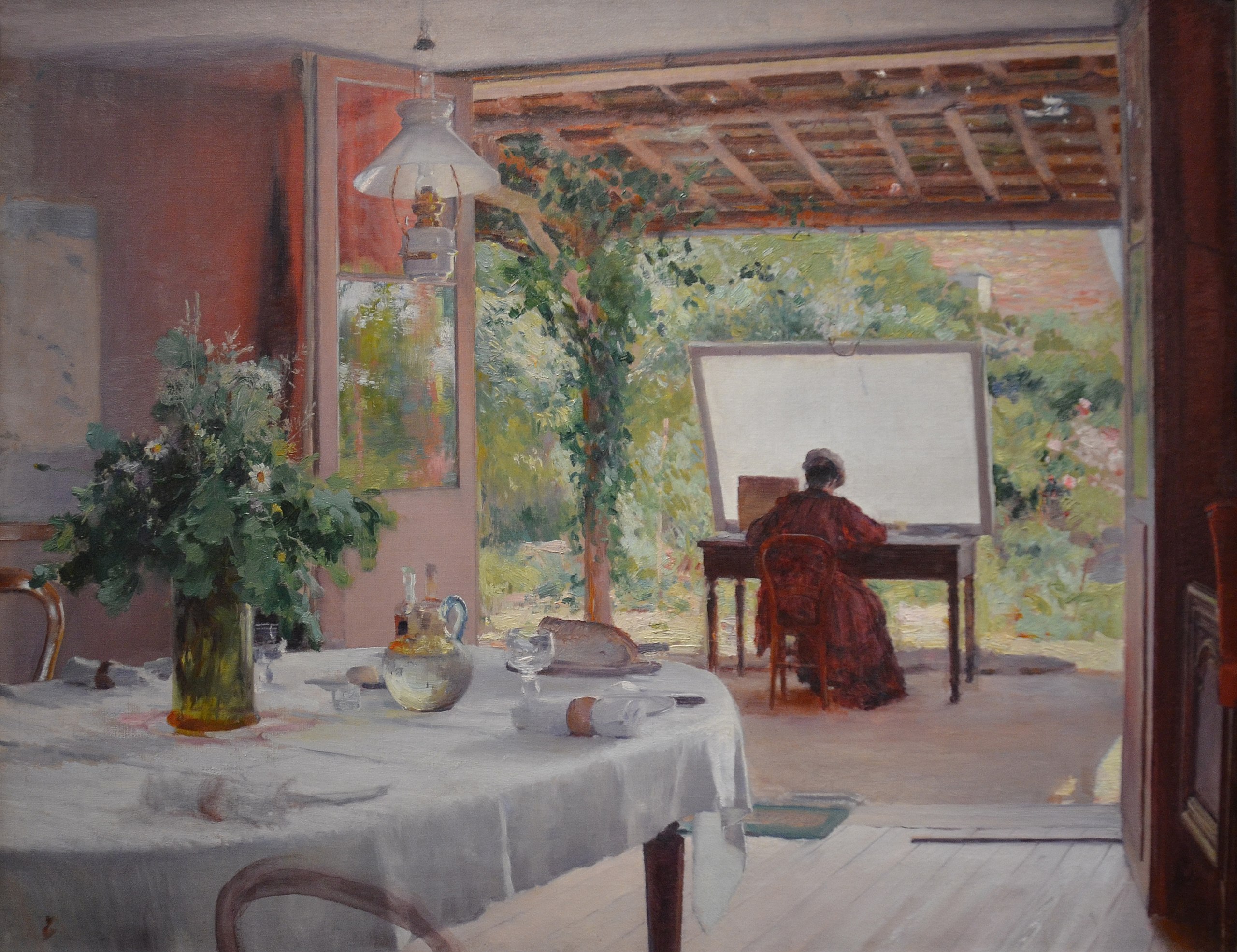
Open air studio, c 1885–90 by William Blair Bruce
After a year in Hamilton, Bruce returned to Paris in 1886 and settled in Giverny with several American artist friends, including Theodore Robinson, a close associate of Claude Monet. The experience profoundly influenced Bruce’s style: his large, academic figural works were replaced by smaller, vividly coloured landscapes painted in a pure Impressionist mode.

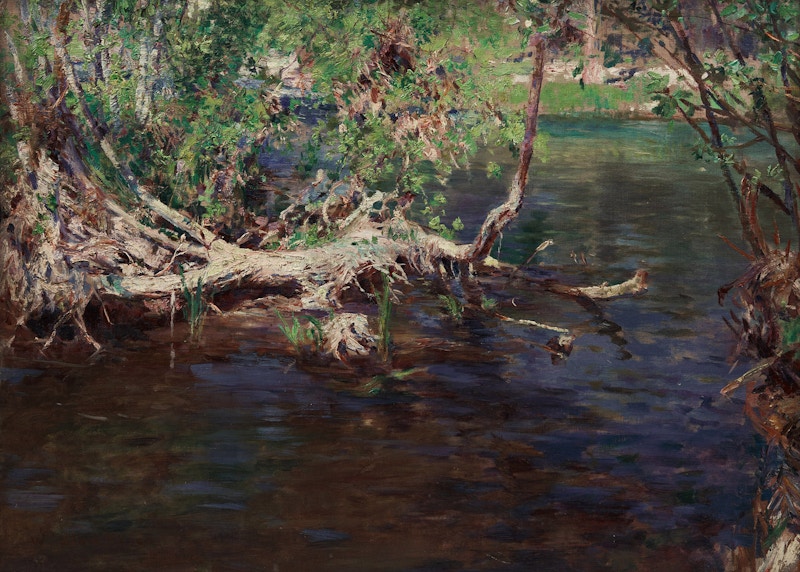
Untitled (Spring Landscape), oil on canvas by William Blair Bruce
On December 4, 1888, Bruce married Swedish sculptor Carolina Benedicks at the British embassy in Stockholm. Over the following decades, the couple traveled extensively, visiting Paris, Capri, Italy, Hamilton, and increasingly Stockholm and Gotland, Sweden. Around 1900, they built their primary residence and studio, Brucebo, near Visby on Gotland. Here, Bruce continued to paint, creating portraits of his wife, twilight views of Stockholm, and scenes of the surrounding landscape.

Study for “The Smiths”, 1893, oil on canvas by William Blair Bruce
Bruce’s career was marked by eclecticism. His works range from portraits and landscapes to genre scenes, mythology, and the nude, oscillating between Impressionist and academic styles with echoes of Whistler, the Barbizon School, and Scandinavian romanticism. Nonetheless, he achieved significant recognition during his lifetime, exhibiting 15 times at the Paris Salon between 1882 and 1906, as well as at the Universal Exposition of 1900, the Royal Academy of Arts in London, the Royal Canadian Academy of Arts in Toronto, an exhibition of over 130 works in Stockholm in 1897, and the Pan-American Exposition of 1901 in Buffalo, where he won a gold medal. Bruce died suddenly in Stockholm on November 17, 1906, at the age of 47, while working on a large canvas. Following his death, a posthumous exhibition of 122 works was held in Paris in 1907.
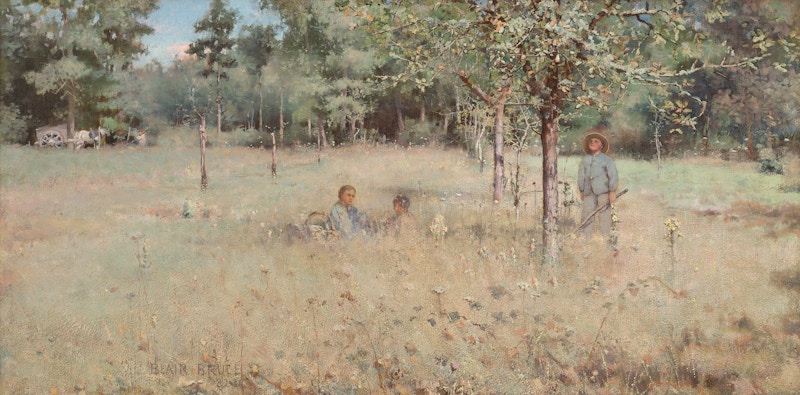
Picking Pears in Barbizon (The Pear Orchard), 1882, by William Blair Bruce
Bruce’s widow Carolina later donated 29 of his paintings to the City of Hamilton, forming the foundation of what is now the Art Gallery of Hamilton, which holds the largest collection of his works outside Brucebo. The Brucebo estate continues to honor their legacy, including scholarships for Canadian art students each summer. William Blair Bruce remains a pivotal figure in Canadian art history, notable for both his early academic achievements and his contributions to Impressionist painting.
Consignment at Rookleys
At Rookleys Canadian Art, we are actively seeking works by William Blair Bruce for consignment, offering consignment rates far lower below what auction houses charge. If you have a painting by William Blair Bruce to consign, please contact us at info@rookleys.com to discuss these opportunities further.
Sources
Wistow, David. “BRUCE, William Blair.” Dictionary of Canadian Biography, vol. 13. University of Toronto/Université Laval, 1994–. https://www.biographi.ca/en/bio/bruce_william_blair_13E.html
“William Blair Bruce.” Uno Langmann Limited – Fine Art & Antique Dealers. https://www.langmann.com/artists/william-blair-bruce
“History.” Art Gallery of Hamilton. https://www.artgalleryofhamilton.com/about-the-agh/history/
“W. Blair Bruce.” National Gallery of Canada – Collection. Accessed December 8, 2025. https://www.gallery.ca/collection/artist/w-blair-bruce