Ric Evans (January 10, 1946 – August 12, 2025) was a leading Canadian abstract painter whose work in geometric abstraction contributed to the national art scene for over five decades. Born in Toronto, Evans developed a rigorous yet intuitive visual language grounded in structure, colour, and line. His practice, which he described as “orbital”, continuously returned to a central formal idea while allowing new observations and considerations to evolve within each body of work. Through this sustained exploration, Ric Evans established a distinctive voice in Canadian abstract art, combining clarity, discipline, and expressive subtlety.
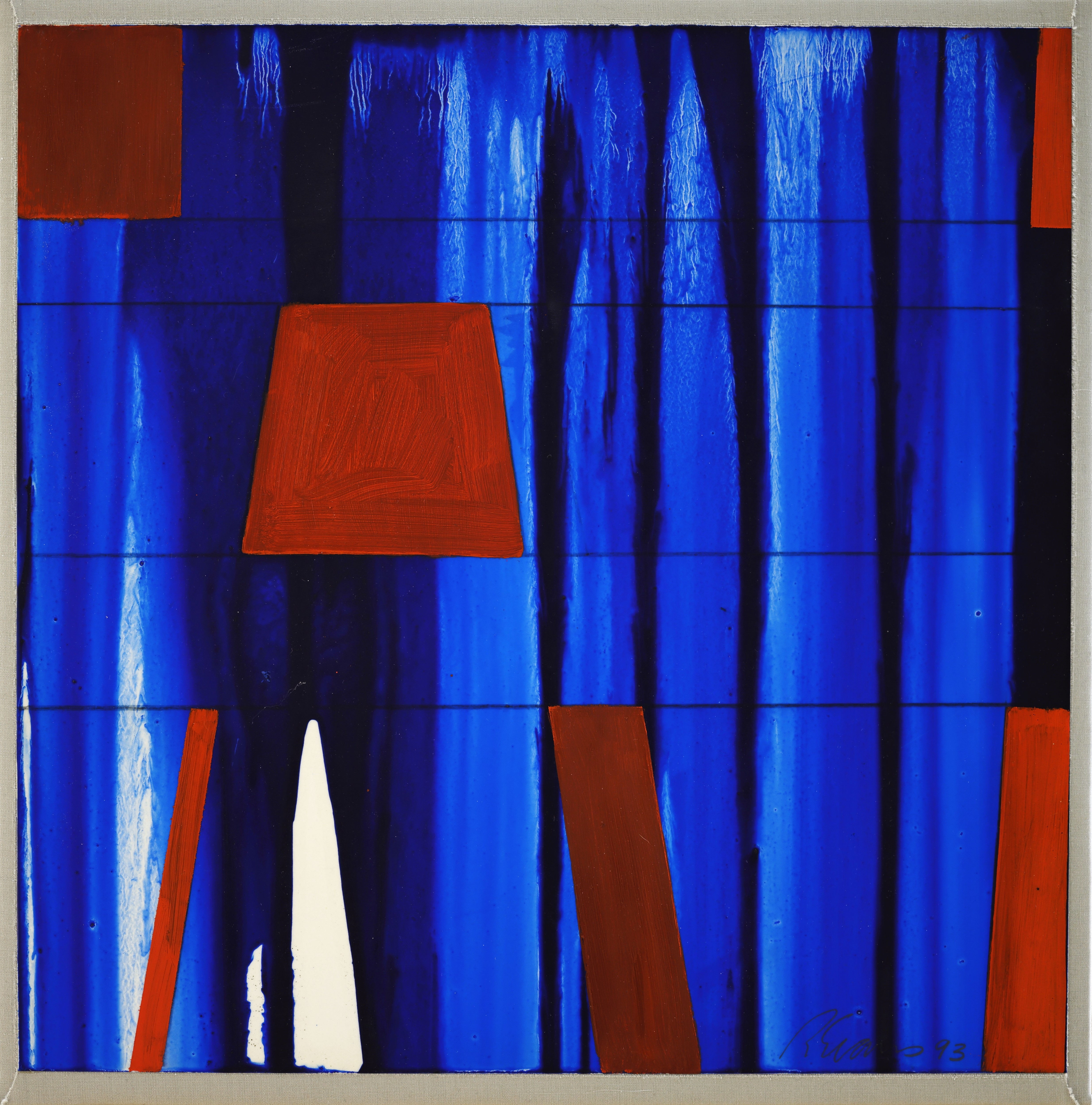 Ric Evans; Natural Momentum
Evans began his formal training at the Ontario College of Art in the late 1960s, emerging during a pivotal moment in the development of contemporary abstraction in Canada. His early promise was evident in 1969 group exhibitions at Hart House Gallery and Scarborough College Gallery at the University of Toronto. These formative exhibitions marked the beginning of a lifelong commitment to geometric abstraction and systematic painting. By the mid-1970s, his structured and constructive oil paintings were featured in a major group exhibition at the Art Gallery of Ontario.
Throughout the 1970s, Ric Evans played an active role in the artist-run movement that transformed contemporary art in Canada. He exhibited with the Toronto Artists’ Cooperative and was one of twelve founding artists of Mercer Union, the influential artist-run centre that remains a cornerstone of Canada’s contemporary art landscape.
 Ric Evans; More Momentum
The 1980s and 1990s saw Evans’ work reach broader national and international audiences. He exhibited at the Alberta College of Art, the Institute of Contemporary Art in Sydney, Australia and was frequently represented at Art Toronto.
Ric Evans’ artistic philosophy centred on clarity and informed intuition. He combined form and colour in carefully calibrated yet playful compositions, drawing inspiration from lived experience and close observation of the natural world. Colour, for Evans, was never ornamental; it functioned as a structural element used to clarify shape and line. His surfaces were meticulously developed yet never overworked, and his lines — whether measured, projected, or intuitively placed — created the structural rhythm of each composition. In his practice, line served not merely as a visual device but as a guiding principle that unified his entire body of work. By revealing the inherent qualities of colour rather than attempting to dominate them, Evans achieved a balance between systematic construction and exploratory freedom.
Ric Evans’ paintings are held in numerous museum and corporate collections across Canada, including the Art Gallery of Ontario. In 2015, he completed a major large-scale commission for a prominent lobby space in one of the Toronto Dominion Towers in downtown Toronto.
His work was also included in Roald Naasgard’s influential volume Abstract Painting in Canada (Douglas & McIntyre, 2008), situating Evans within the broader historical narrative of Canadian abstraction.


