

Manly Edward MacDonald (August 15, 1889 – April 10, 1971) was a prominent Canadian painter best known for his semi-Impressionist landscapes, rural genre scenes, and portraits rooted in southern Ontario. Born in Point Anne near Belleville, Ontario, MacDonald became widely regarded as an “Interpreter of Old Ontario,” capturing en plein air scenes of farms, villages, working horses, mills, streams, logging camps, sap collection, ploughing, cutting ice and fishing. His work stands as an important visual record of historic Ontario life in the early twentieth century.
 Manly MacDonald; Harvesting Time
MacDonald showed artistic promise at an early age and pursued formal training at the Ontario College of Art (now OCAD University) beginning in 1908. In 1911 he studied at the Albright School of Art in Buffalo, New York, and from 1912 to 1913 continued at the School of the Boston Museum of Fine Arts. He returned to Toronto for further study at the Ontario College of Art between 1914 and 1916. In 1917 he received a scholarship from the Royal Canadian Academy of Arts (RCA), enabling him to travel in Europe during the First World War. While overseas he absorbed European traditions yet remained committed to a distinctly Canadian subject matter.
In 1918 MacDonald was commissioned by the Canadian War Memorials Fund, in association with the National Gallery of Canada, to document Canada’s war effort. His Women in War series portrayed women working in agricultural roles while men were overseas; his painting Land Girls Hoeing is now in the collection of the Canadian War Museum in Ottawa. A second RCA scholarship in 1920 allowed him to travel again through France, Italy, Spain and Great Britain, further refining his technique and expanding his international exposure.
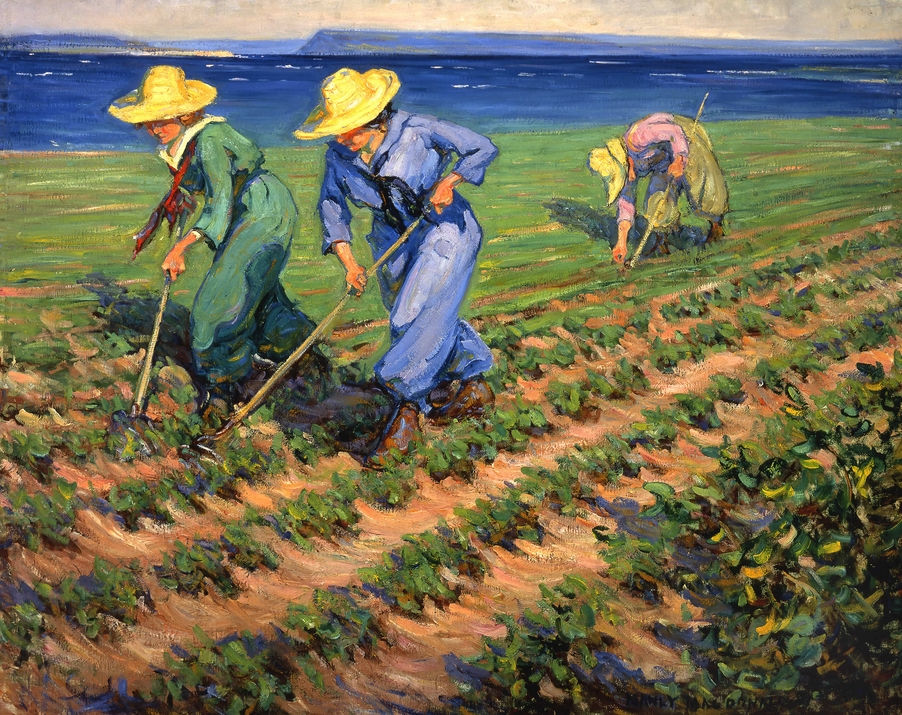 Manly MacDonald; Land Girls Hoeing
By 1922 MacDonald was painting full time, dividing his time between a Toronto studio and Belleville, where he held his first public exhibition. He exhibited internationally at the British Empire Exhibition at Wembley in 1924 and 1925, at the Tate Gallery in London in 1938, and at the 1939 New York World’s Fair. His work was also included in major Canadian exhibitions such as the Art Gallery of Toronto’s “Pictures by Canadians” and the Canadian National Exhibition. Over four decades, his imagery reached a broad audience through the Coutts and later Coutts-Hallmark Canadian Christmas card series.
MacDonald was elected to the Ontario Society of Artists (OSA) in 1918 and became an Associate, and later an Academician, of the Royal Canadian Academy of Arts. He taught at both the Royal Canadian Academy in Toronto and the Ontario College of Art during the 1940s and again in later years, influencing a generation of students while continuing to paint and accept commissions. In 1958 he became a founding member of the Ontario Institute of Painters (OIP).

Manly MacDonald; Near Lake Simcoe
Throughout his career, MacDonald remained committed to traditional representation at a time when modernism was reshaping Canadian art. In 1951 he and several colleagues resigned from the OSA in protest over what he viewed as an increasing emphasis on modern art. Despite the controversy, he continued to receive significant commissions, including two large winter murals for Toronto’s Granite Club in 1955, a series of Eastern Ontario mill paintings for the St. Lawrence Seaway Authority in 1957, and a 1959 painting of the Toronto skyline presented by the City of Toronto to Queen Elizabeth II. That work now forms part of the Royal Collection at Sandringham.
MacDonald worked in oil on canvas and board, as well as in pastel, etching and drypoint. He was particularly admired for his depictions of powerful draft horses in motion, pastoral harvest scenes, South Bay and Prince Edward County landscapes, mills and waterways, and dignified portraits of family members and local figures. His fluid brushwork, strong draftsmanship and harmonious colour conveyed what many regarded as the essential character of rural Ontario.

Manly Macdonald; John Knox's House, Edinburgh
Over the course of his lifetime, MacDonald produced approximately 2,000 works. His paintings are held in major public and private collections, including the National Gallery of Canada, the Art Gallery of Ontario, the Canadian War Museum, the Royal Collection Trust, the John M. Parrott Art Gallery in Belleville, and Loyalist College. He continued to paint until shortly before his death in 1971. Today, Manly Edward MacDonald is recognized as an important twentieth-century Canadian artist whose landscapes and genre scenes preserve the cultural and agricultural heritage of Ontario with warmth, technical skill and enduring appeal.