


"Even when I was a child, I wanted to be a painter, but my father had too many children to educate me in art, so I had to make my own way. I taught myself by copying everything that came under my eye,"
Frederick Sproston Challener RCA (July 7, 1869 – September 30, 1959) was a Canadian painter, draftsman, and educator whose career encompassed both major mural commissions and a substantial body of paintings in oil, watercolour, pastel, and charcoal. While widely known for his decorative work in public buildings, Challener was equally accomplished as an easel painter, producing refined, realistic, and romantic compositions that earned national recognition and are now held in major Canadian public collections.
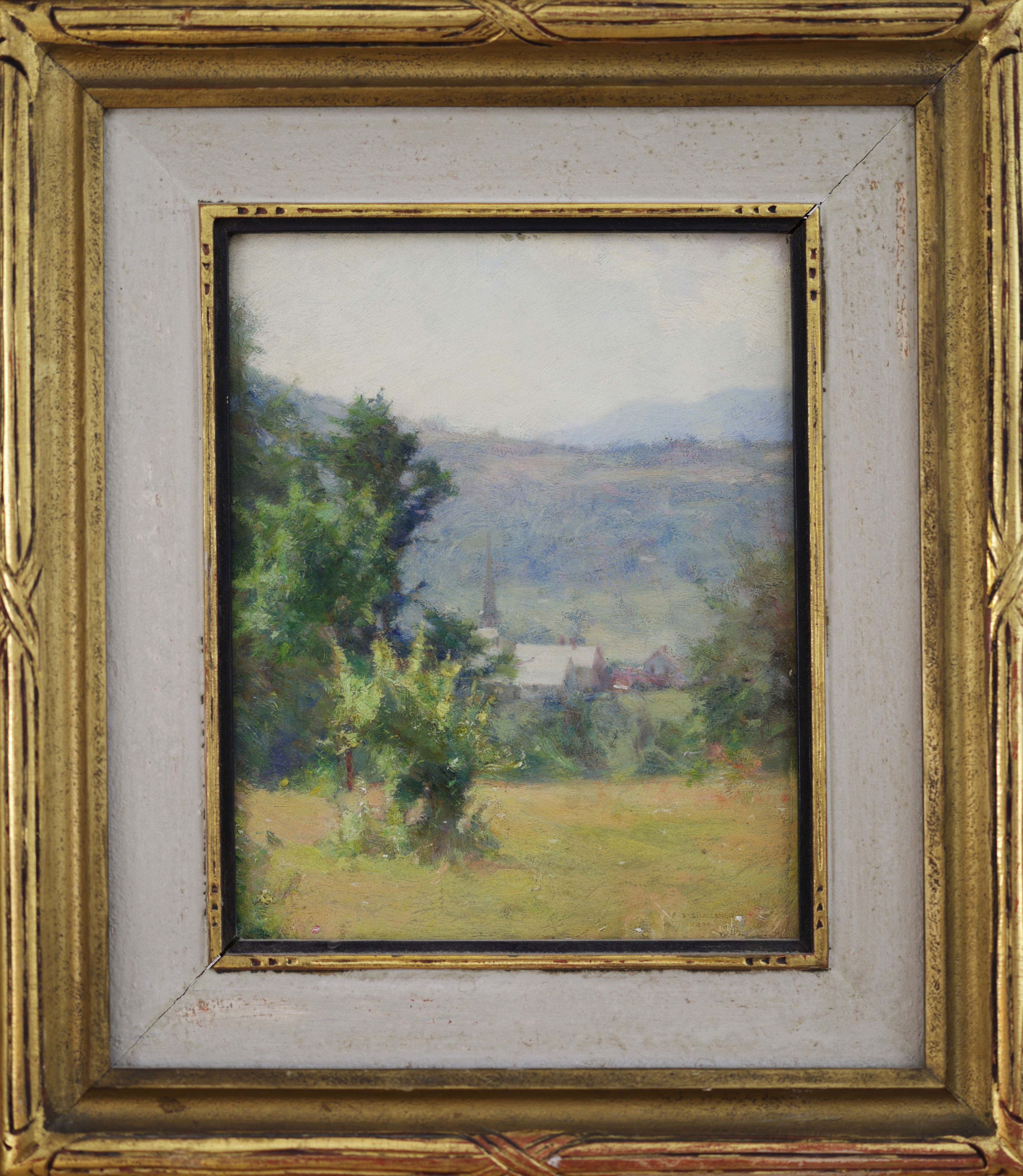
Frederick Challener; Church in the Valley
Born in Whetstone, Middlesex, England, Challener came to Canada as a child and settled in Toronto, where he would live and work for much of his life. His artistic talent emerged early while he was employed as an office boy in a Toronto business firm, where he habitually sketched the crowds outside his window. His drawings came to the attention of artist and photographer John Arthur Fraser of the Notman and Fraser studio, who supported his enrolment in evening classes at the Ontario School of Art (now OCAD University). Challener also studied at the Toronto Art Students’ League and received private instruction from George Agnew Reid, forming a lifelong friendship with Reid while working at the Toronto Lithographing Company.
 Frederick Challener; A Rest From Work
By the early 1890s, Challener was established as a professional artist, working as a newspaper illustrator and exhibiting regularly with the Ontario Society of Artists and the Royal Canadian Academy of Arts. He became an Associate of the Royal Canadian Academy in 1891 and was elected a full Academician in 1899. His paintings from this period demonstrate a confident command of figure, interior, and genre subjects, marked by careful drawing, subtle colour harmonies, and a strong sense of atmosphere.
Challener’s reputation as an painter was firmly established with A Singing Lesson (1900), exhibited at the Royal Canadian Academy and later shown in Montreal and the United States. Contemporary critics praised the painting for its freshness, sentiment, and technical finish, with the Ottawa Evening Journal describing Challener as “one of Canada’s most promising and original artists.” The work remains one of his best-known paintings and exemplifies his interest in intimate, thoughtfully composed interior scenes.
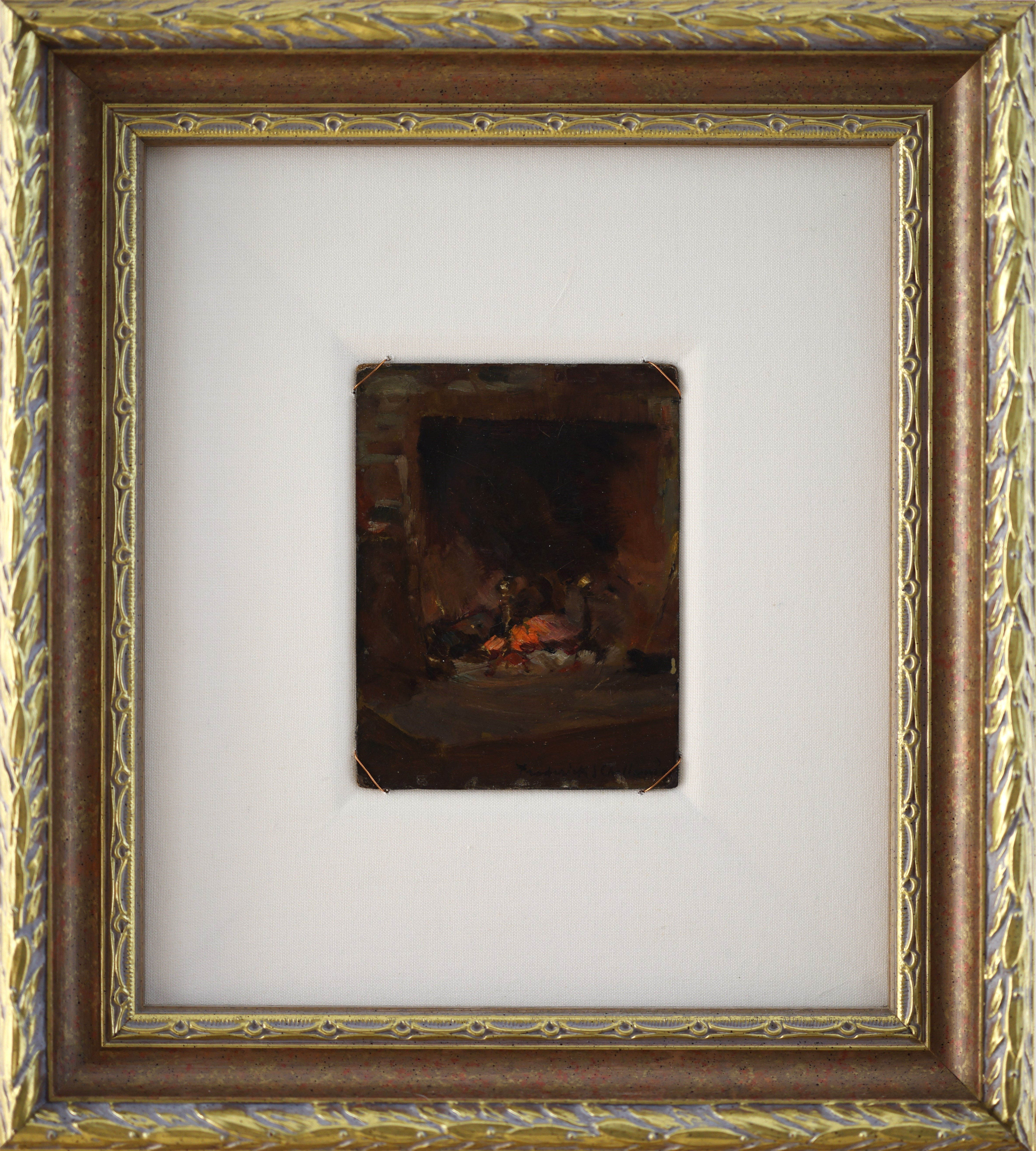 Frederick Challener; A Glowing Hearth
In 1898–1899, Challener travelled extensively through England, Italy, Egypt, Palestine, and Syria. While this journey influenced his later decorative work, it also reinforced his interest in strong composition, luminous colour, and carefully structured pictorial space. Throughout his career, Challener continued to paint landscapes, figures, and genre scenes alongside his mural commissions.
His easel work received international recognition when he was awarded a bronze medal at the Pan-American Exposition in Buffalo in 1901 for The Workers of the Fields, which he submitted as his Royal Canadian Academy diploma work and which is now in the collection of the National Gallery of Canada. He received a further bronze medal at the 1904 Louisiana Purchase Exposition (St. Louis World’s Fair). These honours placed him among the leading Canadian painters of his generation.
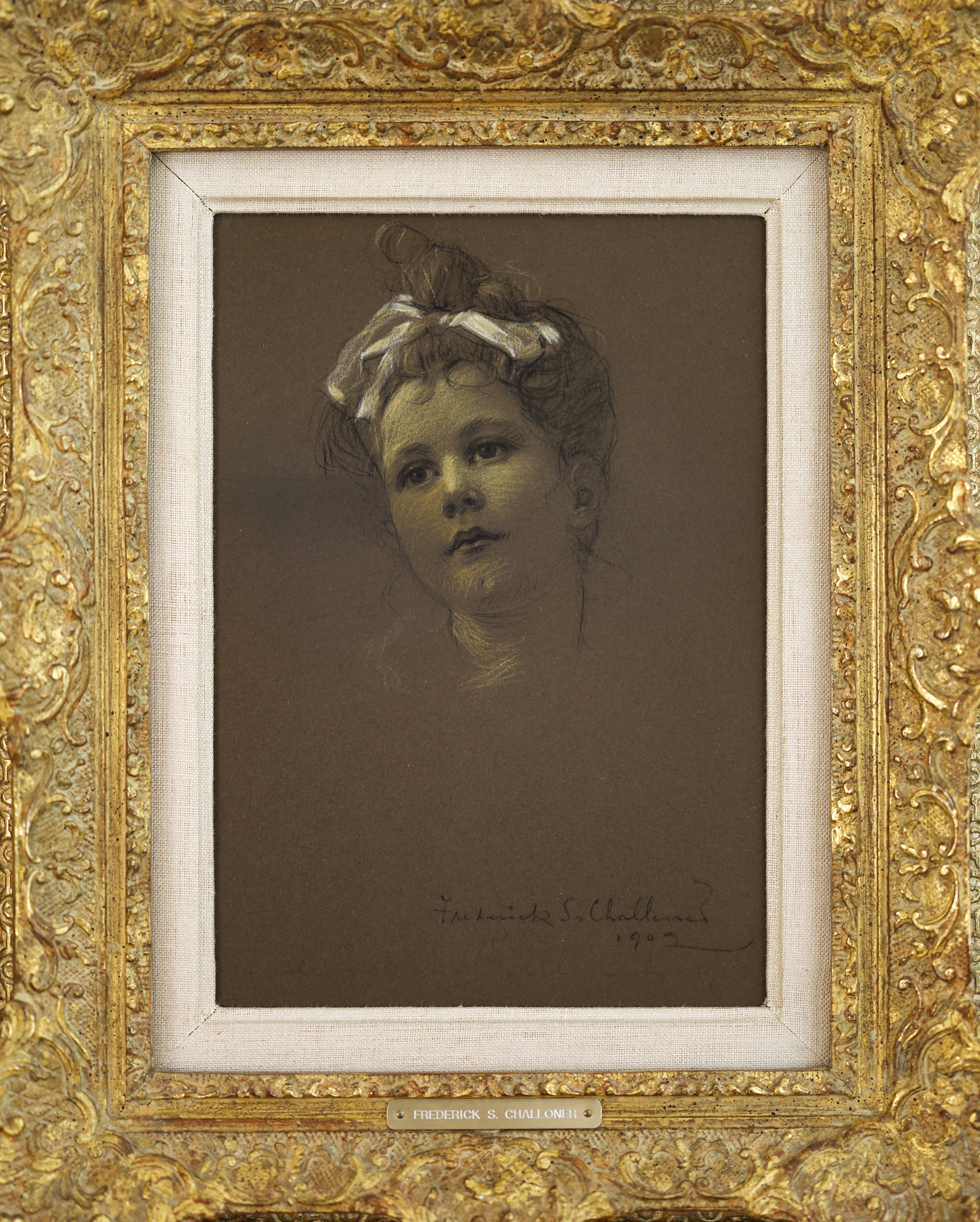
Frederick Challener The Quiet Gaze
Challener worked primarily in oil for larger canvases, while smaller works were often executed in watercolour. His drawings—frequently on wove paper—employ charcoal, black chalk, graphite, and pastel, and demonstrate a strong linear sensibility and sensitivity to light and tone. A number of these drawings are preserved in the National Gallery of Canada, underscoring the importance of his works on paper within his overall oeuvre.
Although mural painting formed a significant part of his professional life, Challener continued to exhibit paintings regularly throughout his career. He showed frequently with the Ontario Society of Artists from 1890 into the 1950s, with the Royal Canadian Academy until 1948, and at exhibitions organised by the National Gallery of Canada and the Art Gallery of Ontario. His work reflects a consistent commitment to representational painting at a time when Canadian art was undergoing significant stylistic change.
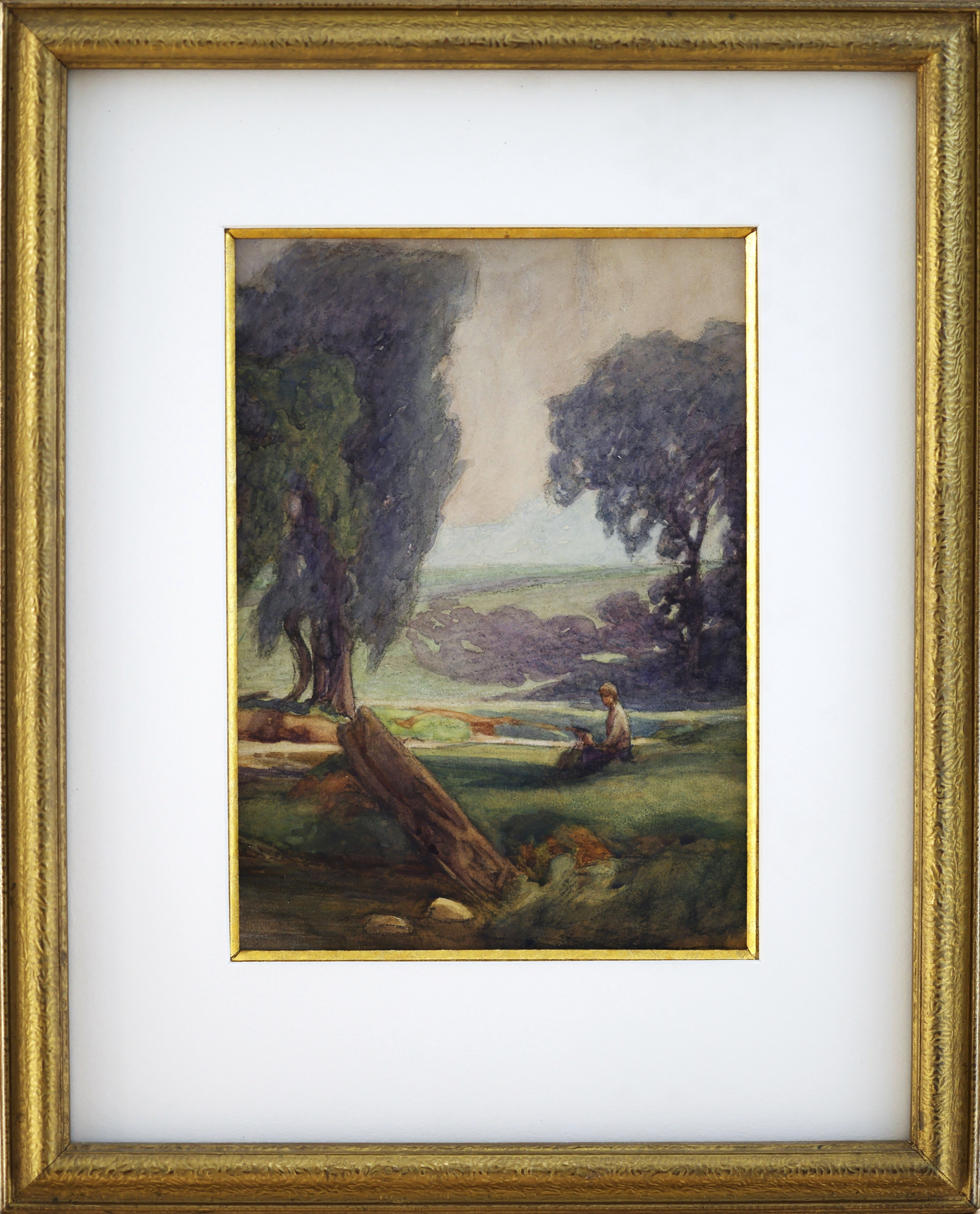 Frederick Challener; Woman by River's Edge
During the First World War, Challener served as an official artist for the Canadian War Memorials Department, producing historically important paintings including Canada’s Grand Armada, now in the Canadian War Museum. In later years, he balanced his studio practice with teaching, serving on the faculty of the Ontario College of Art from 1927 to 1952. During this period, he also assembled extensive research files on Canadian artists, now held in the Edward P. Taylor Library & Archives at the Art Gallery of Ontario.
Frederick Sproston Challener died in Toronto at the age of 90. Today, his paintings, drawings, and watercolours are held in major public collections including the National Gallery of Canada, the Art Gallery of Ontario, the Winnipeg Art Gallery, the Robert McLaughlin Gallery, and the Canadian War Museum. He is remembered as a skilled and versatile painter who made a lasting contribution to early twentieth-century Canadian art.